The tools incident response firms deploy for rapid endpoint visibility during a breach

Co-founder and CCO
For rapid endpoint visibility during a breach, incident response firms deploy live-response agents such as Rapid7 Velociraptor, Google's GRR Rapid Response and LimaCharlie, forensic data collection across the endpoint fleet with CrowdStrike Falcon Forensics, triage programs such as KAPE, investigation platforms such as Cyber Triage that take evidence from DFIR collectors, EDR telemetry and disk images, remote disk and memory access through F-Response, and PowerShell frameworks such as Kansa. The tools differ in how they reach the endpoint: an agent the responder queries across the whole fleet, forensic data collected from hosts and then analyzed, or a remote connection to the disk and memory. LimaCharlie sensors report in within seconds, can sit dormant in sleeper mode on a client's fleet until an incident starts, and run Velociraptor, Hayabusa and Plaso jobs as extensions.
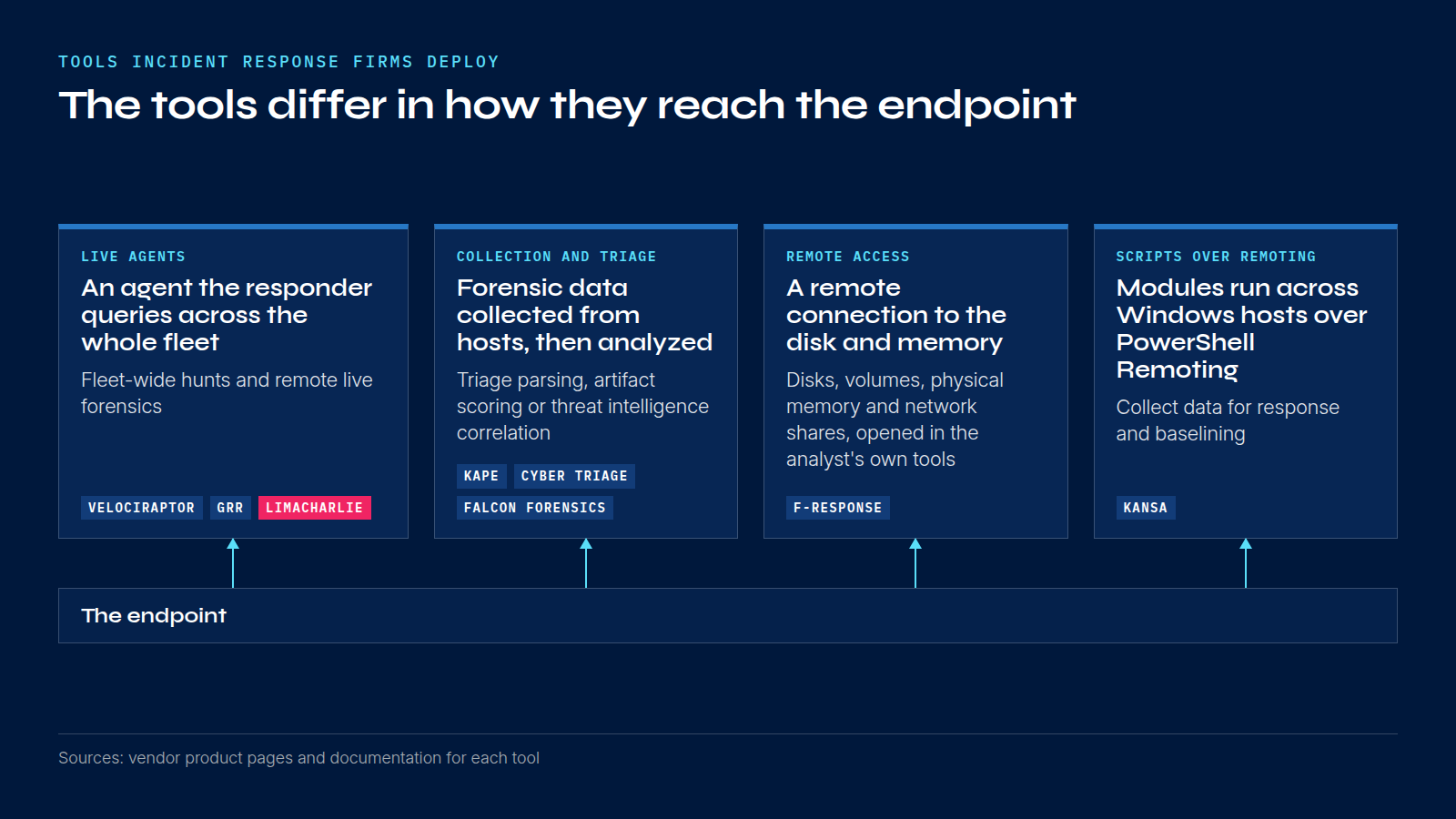
This post sorts the options by how they reach the endpoint, says what each one is good at, and says where LimaCharlie fits and where another tool is the better choice.
Tools incident response firms deploy for rapid endpoint visibility
Tool | How it reaches the endpoint | What it gives a responder |
|---|---|---|
Open-source client and server, plus offline collectors | Fleet-wide hunts written in VQL, and prebuilt collectors for hosts with no client | |
Open-source Python agent and server | Remote live forensics for fast, scalable triage | |
Automated collection across the endpoint fleet | Point-in-time and historic forensic data on Windows, macOS and Linux, correlated with threat intelligence | |
Sensor on Windows, macOS, Linux and ChromeOS that streams to the cloud | Streaming EDR telemetry, a year of searchable history, response actions and artifact collection | |
Run on a device or storage location | Targeted file collection, then parsing with one or more programs | |
The Cyber Triage Collector, EDR telemetry and disk images | Scored artifacts and guided analysis in a shared workspace | |
Remote, read-only access over the network | Disks, volumes, physical memory and network shares, opened in the analyst's own tools | |
PowerShell Remoting | Modules run across Windows hosts to collect data for response and baselining |
Live agents you can hunt across
Velociraptor collects forensic evidence from many endpoints at once, hunts with a library of forensic artifacts, and monitors endpoint events continuously. Its own documentation describes hunting the environment: running triage artifacts across every host to zero in on compromised assets. When a host has no client, Velociraptor builds offline collectors, binaries with the configuration and artifacts embedded that write a collection container to disk or upload it to cloud storage. It fits firms that will run their own Velociraptor server, in the cloud or on premises.
GRR Rapid Response is an incident response framework focused on remote live forensics, with a Python client on each target system and Python server infrastructure that manages the clients. GRR started at Google and is open source under the Apache License 2.0; it fits teams comfortable operating that server themselves.
Triage collection and analysis
KAPE, the Kroll Artifact Parser and Extractor, is primarily a triage program: it finds the most forensically relevant artifacts on a device or storage location and parses them within a few minutes, so investigators can find and prioritize the systems that matter most to the case. Cyber Triage imports data from a SIEM, from EDR telemetry and directly from endpoints through its Collector, then scores artifacts as bad, suspicious, good or unknown.
CrowdStrike Falcon Forensics automates point-in-time and historic forensic data collection across the endpoint fleet, with enrichment and correlation against threat intelligence. See LimaCharlie vs CrowdStrike for a side-by-side comparison.
Remote disk and memory access
F-Response gives read-only remote access to physical disks, logical volumes, physical memory, cloud servers and network shares. If your analysis software reads a hard drive or a network share, it works with F-Response, so a firm keeps the imaging and analysis tools its examiners already know.
Scripts over remoting
Kansa is a modular PowerShell framework that uses PowerShell Remoting to run modules across hosts in an enterprise; its code was last updated in November 2022. It suits Windows estates where PowerShell Remoting is already allowed.
When the firm brings its own tools
Some buyers are choosing a responder, and the tool comes with the team. For CrowdStrike Incident Response Services, experts deploy globally within hours, and the Mandiant Retainer offers a two-hour response time in the event of a breach, with prenegotiated terms. A retainer like these suits an organization that wants someone else to run the investigation.
Where LimaCharlie fits
LimaCharlie is cloud-hosted security operations infrastructure that serves as an EDR or XDR, a SIEM, or both. For an incident response firm, the parts that bear on speed and visibility are these:
Deployment: generate an installation key, push sensors to affected systems, and they report in within seconds. Telemetry streams to the cloud over a TLS connection, and response actions run on the endpoint within 100 milliseconds of the triggering behavior.
Sleeper mode: firms on retainer pre-deploy sensors that stop collecting telemetry while tagged
lc:sleeper. Remove the tag and they resume normal operation within 10 minutes. Sleeper billing counts connected time, events processed and events retained, and sleeper mode needs an organization with billing enabled.History: telemetry is retained for a full year, and responders search that history to establish dwell time and initial access.
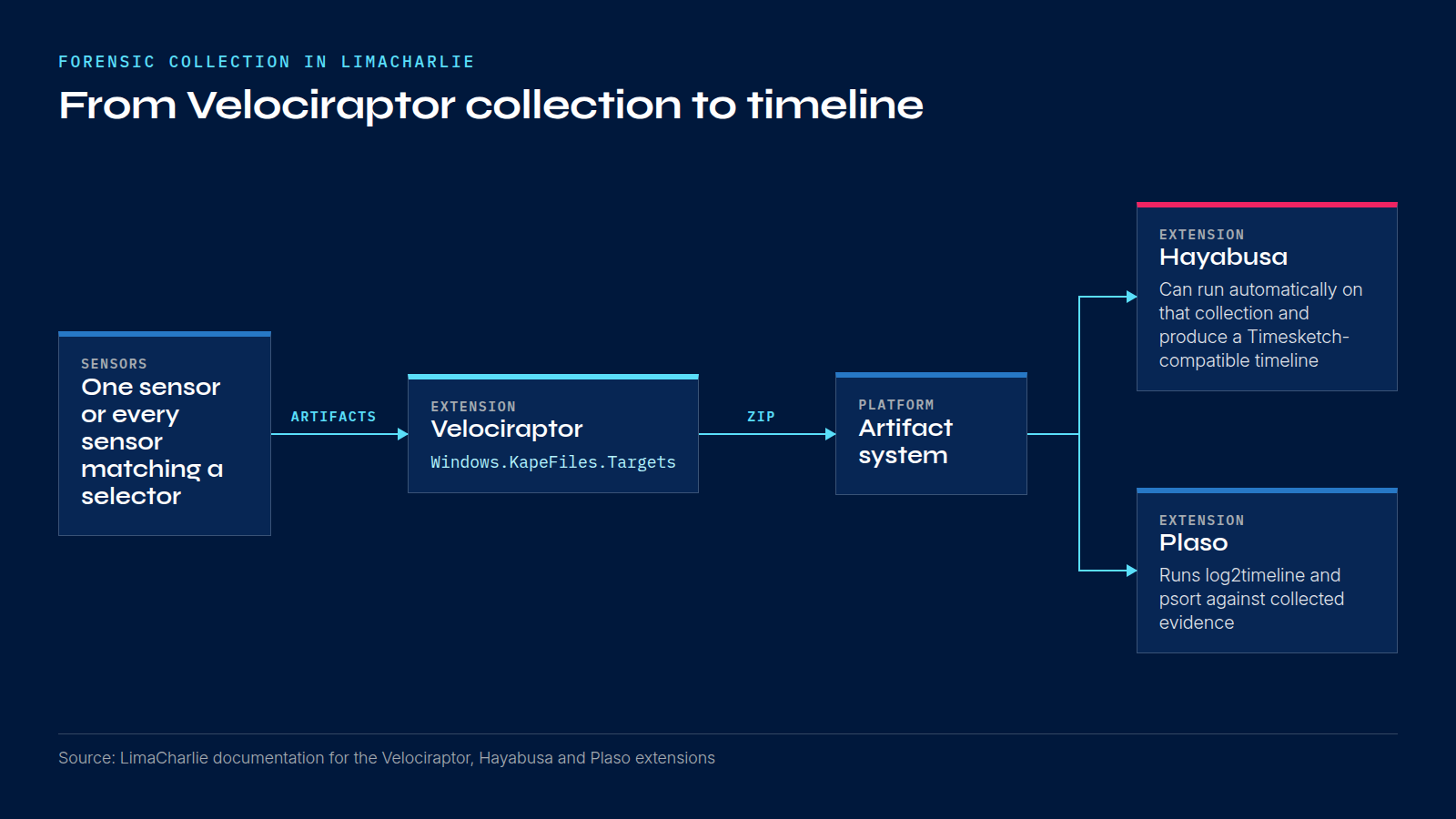
Forensic collection: the Velociraptor extension collects Velociraptor artifacts, including
Windows.KapeFiles.Targets, from one sensor or every sensor matching a selector, and the resulting ZIP lands in LimaCharlie's artifact system. The Hayabusa extension can run automatically on that collection and produce a Timesketch-compatible timeline, and the Plaso extension runs log2timeline and psort against collected evidence.Response: isolate a compromised endpoint while keeping the LimaCharlie channel open, kill processes, run YARA scans across memory and disk, and collect artifacts before remediation destroys them.
Existing EDR: if the client already runs CrowdStrike, SentinelOne or Microsoft Defender, adapters bring that telemetry in and the same detection and response rules run over it.
Engagement economics: each client is its own organization with no contracts and no minimums, so a firm can open a tenant for a three-week engagement and shut it down. Black Hills Information Security cut its cost per endpoint in half while increasing its ability to scale.
Where LimaCharlie is not the right fit
Air-gapped or offline hosts: LimaCharlie sensors stream to the cloud. For a host that cannot reach the internet, a Velociraptor offline collector is the better tool.
Full disk images in your existing forensic suite: F-Response connects your own imaging and analysis software to the remote disk, which suits examiners who need the whole volume.
Self-hosted only: If policy requires every server on premises, Velociraptor and GRR both run on infrastructure you operate.
A team to run the investigation: LimaCharlie is infrastructure for responders; a retainer with CrowdStrike or Mandiant buys the investigators themselves.
The categories also combine. A responder can use LimaCharlie as the live agent for fleet-wide hunting and response, and run Velociraptor's KAPE-based collections through the same sensors.
Try LimaCharlie free today. Just sign up for the free tier on our website.
440 N Barranca Ave #5258
Covina, CA 91723
5307 Victoria Drive #566
Vancouver, BC V5P 3V6
Stay up-to-date on all things LimaCharlie with our monthly newsletter.
This site is protected by reCAPTCHA and the Google Privacy Policy and Terms of Service apply.