The best Splunk alternatives for a security team, compared

Co-founder and CCO
The best Splunk alternatives for a security team depend on the stack you already run; the ones to compare are Microsoft Sentinel, Google Security Operations, CrowdStrike Falcon Next-Gen SIEM, Palo Alto Networks Cortex XSIAM, Elastic Security, Panther, Datadog Cloud SIEM, Exabeam, Graylog, and LimaCharlie. Pick the SIEM that sits closest to the tools and data your team already depends on, then check what its license includes for retention and response. LimaCharlie fits teams, and especially service providers, that want endpoint telemetry, log ingestion, and a year of searchable data on one usage-billed system.
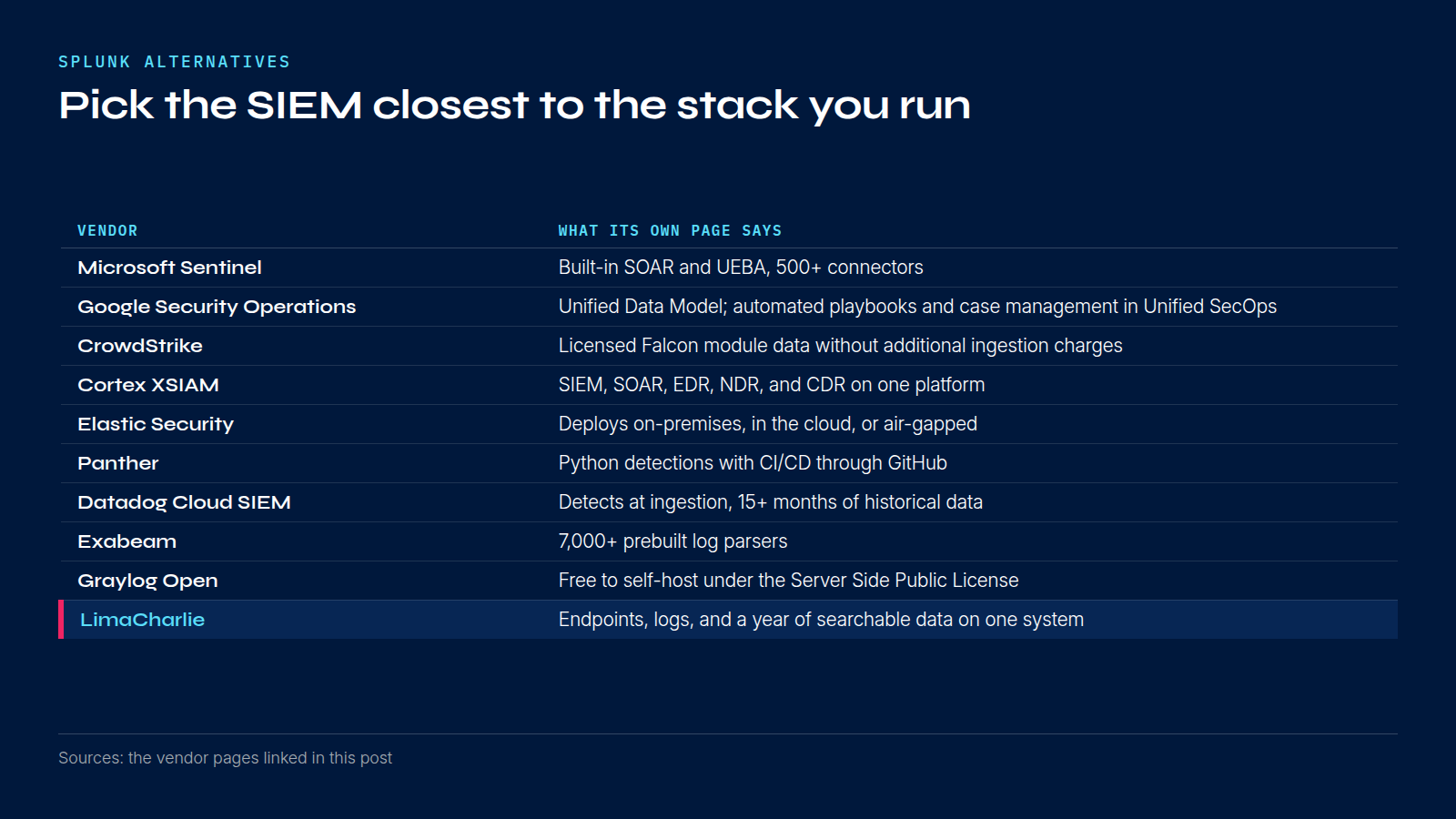
Below is what each of these Splunk alternatives does well, in each vendor's own words, followed by where LimaCharlie fits and where it does not.
How to compare Splunk alternatives
Splunk calls Enterprise Security "a unified TDIR platform" integrated with agentic AI, SOAR, UEBA, and SIEM, and its purchasing table lists UEBA and SOAR for the Premier edition only, with neither in the Essentials edition. Splunk Enterprise runs on-prem, in a private cloud, or hybrid, and Splunk Cloud Platform is a data platform "hosted in the cloud". Any replacement should be compared on the same points:
Where it runs: SaaS, your own cloud account, on-prem, or air-gapped.
What your analysts will query in, and whether your existing detections convert.
How long data stays searchable, and what that costs.
Whether response, case management, and behavioral analytics are included or sold separately.
The best Splunk alternatives for a security team
Microsoft Sentinel
Sentinel is a cloud-native SIEM with 500+ connectors, built-in SOAR and UEBA, and a built-in data lake for retention. Hunting and analytics rules use Kusto Query Language. Pricing is based on the data you ingest, store, and consume. Plan for one change: after March 31, 2027, Sentinel will be available only in the Microsoft Defender portal. Microsoft lists a Microsoft Azure subscription as a requirement.
Google Security Operations
Google SecOps SIEM is a cloud service built on Google infrastructure, and Google says you can examine aggregated security data "going back for months or longer". Data is normalized into its Unified Data Model. For response, Google says Unified SecOps analysts can "respond quickly and provide resolutions using automated playbooks and case management".
CrowdStrike Falcon Next-Gen SIEM
Falcon Next-Gen SIEM uses an index-free architecture, and data from licensed Falcon modules arrives without additional ingestion charges. It also analyzes third-party data without other Falcon modules. CrowdStrike also features Charlotte Agentic SOAR, which it says "brings reasoning, automation, and human oversight together with configurable autonomy," so ask whether your SIEM quote includes it. See also LimaCharlie vs CrowdStrike.
Palo Alto Networks Cortex XSIAM
Cortex XSIAM lists SIEM, SOAR, EDR, NDR, and CDR as its foundational capabilities, which Palo Alto Networks sums up as "every SOC capability on one platform," and ships with 14,500+ detections and 3,600+ analytics models. Palo Alto positions it as a replacement for a traditional SIEM, and its page speaks of "consolidating tools, automating tasks, and boosting efficiency".
Elastic Security
Elastic deploys on-premises, in the cloud, or in air-gapped environments, with 400+ prebuilt integrations that normalize to the Elastic Common Schema. Detection rules are open for review, Elastic says its Threat Hunt skill "runs ES|QL queries against live data," and cross-cluster ES|QL "covers distributed deployments". See also LimaCharlie vs Elastic.
Panther
Panther is now part of Databricks. It runs either inside your AWS account against Snowflake or Databricks, or as a managed cloud, on a security data lake architecture. Detections are written, tested, and versioned in Python with CI/CD through GitHub, and Panther says to write rules "using the same practices you use for application code: version control, peer review, CI/CD, and automated testing".
Datadog Cloud SIEM
Datadog Cloud SIEM is built on Datadog's log management, detects threats at ingestion before indexing, and lets you investigate across 15+ months of historical data. Datadog says it enables "rapid onboarding and an intuitive experience for security, dev, and ops teams".
Exabeam
Exabeam's New-Scale SIEM offers 7,000+ prebuilt log parsers, and LogRhythm SIEM remains its self-hosted option. New-Scale Fusion "combines New-Scale SIEM and New-Scale Analytics," unifies "log management, behavioral analytics, dynamic risk scoring, and automation," and runs on Google Cloud Platform with a 99.5% uptime SLA. Exabeam says its UEBA and Agent Behavior Analytics "automatically baseline activity".
Graylog
Graylog Security runs cloud-native, on-premises, or hybrid, with a built-in data lake that stores logs "without counting against your license" and imports Sigma rules from private GitHub, GitLab, or Bitbucket repositories. Graylog Open is free to self-host under the Server Side Public License.
Also worth comparing: Rapid7 and Securonix
Rapid7 Incident Command is a SIEM with user behavior analytics and detection-as-code workflows. Securonix says Unified Defense SIEM "brings behavioral analytics, detection, investigation, threat intelligence, and response into one cloud-native platform," and that its Advanced Behavioral Analytics "identifies unusual activity across users, identities, and AI agents".
Where LimaCharlie fits
LimaCharlie is cloud-hosted security operations infrastructure that serves as an EDR, a SIEM, or both. For a team replacing Splunk, five properties stand out.
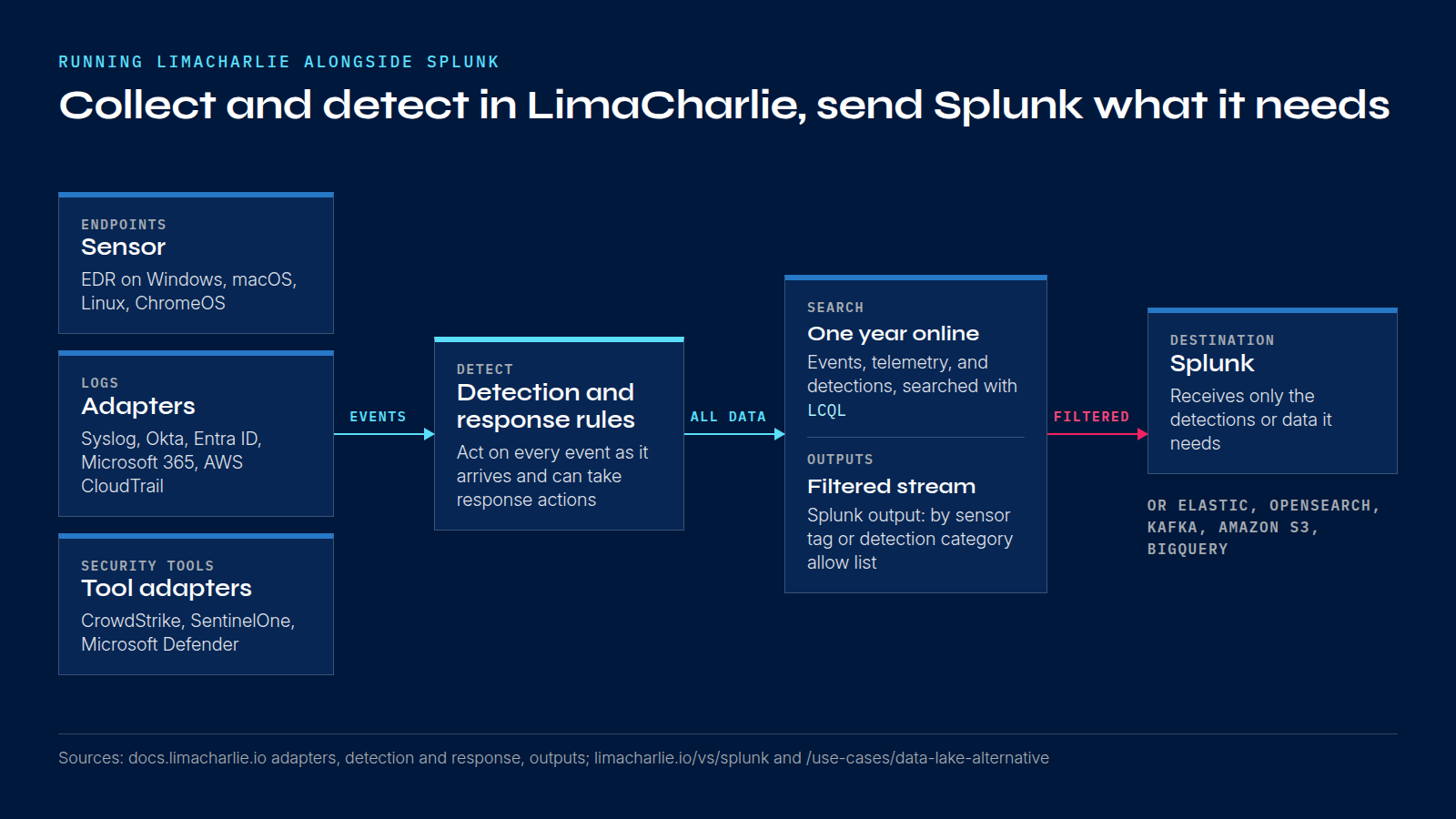
First, endpoint and log data land on the same system. The LimaCharlie sensor provides EDR on Windows, macOS, Linux, and ChromeOS, and adapters ingest syslog, Windows event logs, Okta, Microsoft Entra ID, Microsoft 365, Google Workspace, AWS CloudTrail, and other sources, normalized into LimaCharlie events. There are also adapters for security tools, including CrowdStrike, SentinelOne, and Microsoft Defender.
Second, a year of data stays searchable. Events, telemetry, and detections remain online for one year at no additional storage cost, and you search them with the LimaCharlie Query Language, LCQL.
Third, detection runs as data arrives. Detection and response rules act on every event as it arrives and can take response actions. Sigma rules can be converted into LimaCharlie's format, though converted rules vary in quality and coverage and are not recommended as your starting detection set.
Fourth, you can run it alongside Splunk. Outputs stream data to Splunk, Elastic, OpenSearch, Kafka, syslog, Amazon S3, BigQuery, and other destinations. The Splunk output can send only events from sensors with a given tag, or only the event types on an allow list in its Detection Category section. Where Splunk has to stay, for compliance or organizational reasons, LimaCharlie runs detection natively and routes only what's necessary to it, so only critical data flows to Splunk over its HTTP Event Collector (HEC).
Fifth, it is built for service providers and agents. Each environment is its own organization, so a service provider runs every client from one account. You run LimaCharlie from the web app, the CLI, or the API, and AI assistants operate it through the same CLI. Billing is usage-based and month to month with no contract, and a free Community Edition needs no credit card. Current rates are on the pricing page.
Where LimaCharlie is a poor fit
You want data visualization beyond tracking detections, events, and sensors online over time, which is what the web app shows. For data visualization, you send the data you need to Splunk, Tableau, or another tool of your choice through the public API.
You want behavioral analytics that compare activity to a historical baseline. Sentinel and Splunk ES Premier list built-in user and entity behavior analytics (UEBA), Exabeam says its UEBA and Agent Behavior Analytics "automatically baseline activity", and Securonix says its SIEM brings behavioral analytics. In LimaCharlie you build behavioral detection patterns with detection and response rules and the suppression system, which detect anomalous behavior such as a user logging in from a new country or a host resolving an unusual domain. These patterns use static thresholds over periods of up to 30 days and cannot detect activity that is unusual compared to a historical baseline.
You have a dedicated Splunk team with deep SPL expertise. For that team, Splunk may fit better.
You want a single vendor bill that includes AI usage. With LimaCharlie you bring your own API subscription, your usage is billed directly by those providers, and LimaCharlie does not mark up or resell AI capacity.
How to test a Splunk alternative
Run the candidate in parallel with Splunk on a slice of real data for a few weeks. Port ten of your most-used detections, replay a recent incident, and run the searches your analysts used in it. Then compare three things you can measure: detections that fired, time to answer each search, and the bill for the data you sent. To try LimaCharlie that way, sign up for the free tier at limacharlie.io and point an output at your Splunk instance so both systems see the same events.
440 N Barranca Ave #5258
Covina, CA 91723
5307 Victoria Drive #566
Vancouver, BC V5P 3V6
Stay up-to-date on all things LimaCharlie with our monthly newsletter.
This site is protected by reCAPTCHA and the Google Privacy Policy and Terms of Service apply.