EDR vendors that keep a full year of endpoint telemetry searchable

Co-founder and CCO
Among the seven EDR vendors compared here, LimaCharlie keeps a year of searchable telemetry with one year of storage on every plan, and Sophos states that its SIEM product, an add-on to Sophos XDR and Sophos MDR, "includes 13 months of data retention by default". Microsoft, Palo Alto Networks, Kaspersky and SentinelOne publish shorter defaults: Microsoft Defender for Endpoint keeps data queryable in advanced hunting for 30 days, Cortex XDR lists 31 days of ingested data, Kaspersky EDR Expert stores telemetry for 30 days, and SentinelOne lists 14 days of data retention on Singularity Complete and 90 days on Singularity Commercial. Microsoft, Palo Alto Networks, and Kaspersky each publish a longer option, and CrowdStrike sells longer retention as Falcon Search Retention.
The figures below come from each vendor's own site or documentation, except N-able's Deep Visibility tiers, which come from N-able's status page. Retention terms change with licensing, so confirm the current numbers with the vendor before you sign.
Endpoint telemetry retention by EDR vendor: published figures
Vendor | Published default | Longer option |
|---|---|---|
LimaCharlie | One year of storage on every plan, with a year of searchable telemetry | Stream events to your own storage or SIEM |
Microsoft Defender for Endpoint | 180 days in the portal; 30 days in advanced hunting | Up to 90 days of supported data with an eligible Integrated Security Operations Center (ISOC) license; Microsoft Sentinel data lake is designed for retention up to 12 years, and data stored only there isn't available in advanced hunting |
CrowdStrike Falcon | No figure on the retention page | Falcon Search Retention license for "months or years" |
Palo Alto Networks Cortex XDR | Ingested data 31 days (not listed for Cortex XDR Prevent); query data 186 days | Hot storage add-on (fully searchable) or cold storage (limited search) |
Sophos SIEM product (add-on to Sophos XDR and Sophos MDR) | 13 months of data retention by default in the SIEM add-on, applying to "threat-related telemetry and compliance-focused data" | 3, 5, 7 or 10 years |
SentinelOne Singularity | 14 days of data retention on Singularity Complete; 90 days on Singularity Commercial | N-able announced its own extended retention options for Deep Visibility data in August 2025: 30, 90, 180 or 365 days |
Kaspersky EDR Expert | 60 or 90 days with an Extension module |
The chart below sets each vendor's published figures against a one-year line.
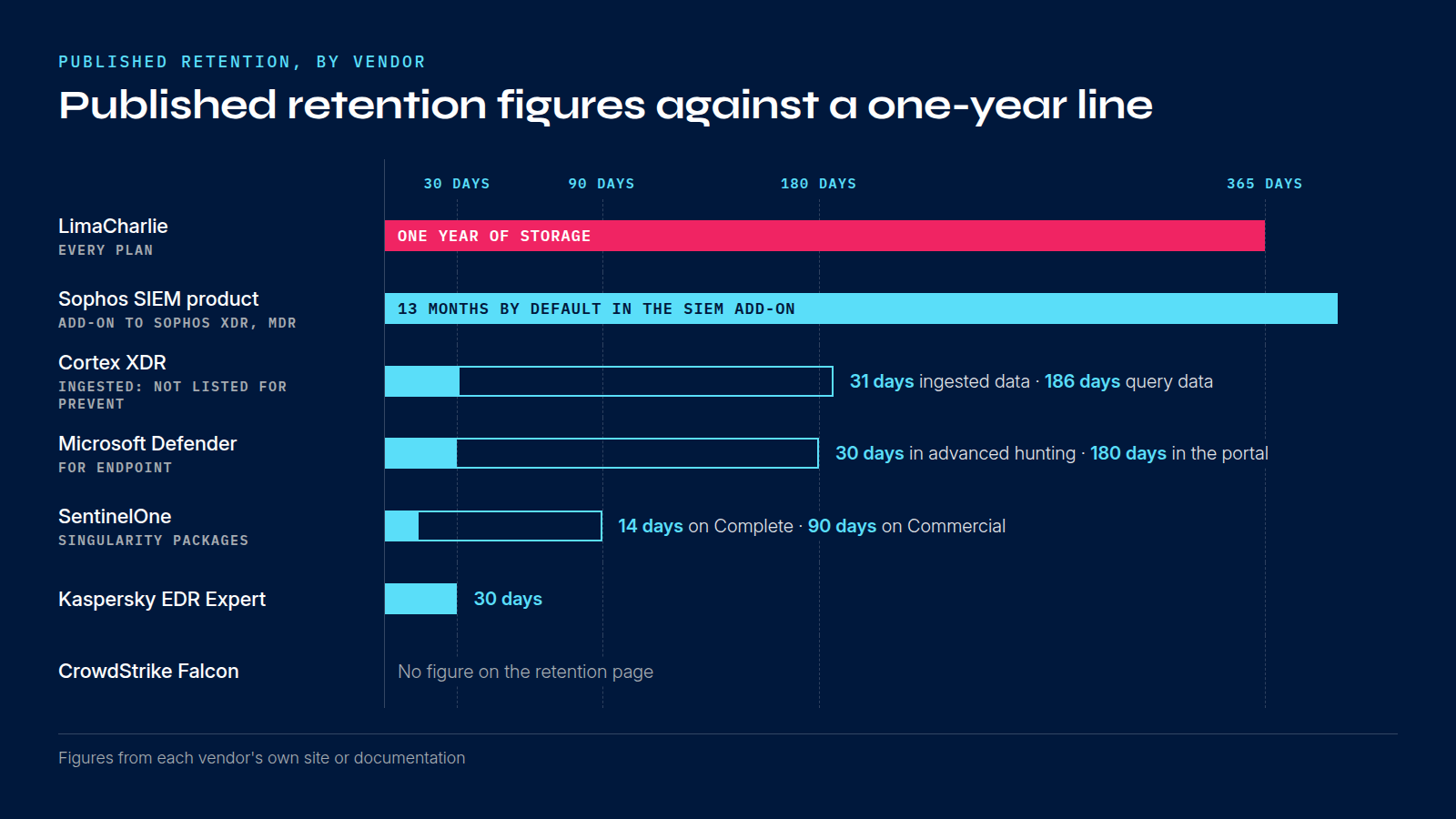
Chart sources, each vendor's own site or documentation: LimaCharlie pricing, Sophos, Cortex XDR docs, Microsoft Learn, SentinelOne, Kaspersky and CrowdStrike.
What each vendor publishes
Microsoft Defender for Endpoint and Sentinel
Microsoft states that Defender for Endpoint data "is retained for 180 days, visible across the portal," and that in advanced hunting "it's accessible via a query for 30 days". With Integrated Security Operations Center (ISOC), customers who have an eligible Microsoft Defender Suite, Microsoft 365 E5 or Microsoft 365 E7 license get 90 days of included retention for supported Microsoft Defender data, Azure Activity data and Office 365 Activity data. For long-term needs, the Sentinel data lake is built for "cost effective retention of large volumes of security data for up to 12 years". One detail for hunters: Microsoft notes that data stored only in the Sentinel data lake is not available in advanced hunting, and says to "use data lake exploration to query that data". When you onboard a Sentinel workspace, advanced hunting can also query its analytics-tier data "according to the retention configured for the workspace".
CrowdStrike Falcon Search Retention
CrowdStrike sells longer retention as Falcon Search Retention, described as "a simple license upgrade" that extends Falcon data storage "for months or years". The page highlights an index-free architecture and a query language that scans all events, with a view across endpoint, user and cloud activity. The retention page does not list a default retention figure for Falcon Insight, so ask CrowdStrike for the window included with your bundle. Our comparison at /vs/crowdstrike covers the wider differences.
Palo Alto Networks Cortex XDR
Cortex XDR publishes a clear retention table. On the per Endpoint, Cloud per Host and per GB licenses it lists 31 days of ingested data (not listed for Cortex XDR Prevent), 186 days of case and issue data and 186 days of query data, and on the per Endpoint and Cloud per Host licenses 365 days of forensic data with the Forensics add-on. The page lists three retention add-ons: additional 31-day hot storage of case and issue data, period-based hot storage, and period-based cold storage. Period-based hot storage is "fully searchable storage for investigation and threat hunting," and for the per Endpoint licenses the page states that it "requires purchasing a minimum of 1 month of the additional retention". Period-based cold storage is "lower cost storage of ingested data for long-term compliance needs with limited search options," with a six-month minimum.
Sophos
Sophos states that its SIEM product "includes 13 months of data retention by default," with options to extend to 3, 5, 7 or 10 years, charged per user and server with no ingestion-based fees. That 13-month default belongs to the SIEM product, which Sophos describes as "an add-on to Sophos XDR and Sophos MDR." Sophos calls the result "all your data, unified and queryable, ready for security operations and compliance". The SIEM product page does not say how much raw endpoint telemetry the 13-month default covers, so check which endpoint data types land in that store for your license.
SentinelOne
SentinelOne's pricing and packages page lists "14 days of Data Retention" for Singularity Complete and "90-Day Data Retention for extended data analysis" for Singularity Commercial. N-able, whose status page refers to "SentinelOne-powered endpoints," announced in August 2025 Deep Visibility retention tiers of "30, 90, 180, or 365-day options," configured at the account level across sites. The same post announced Cloud Funnel, which streams "enriched XDR telemetry from SentinelOne-powered endpoints directly to your cloud storage". Ask SentinelOne what the retention figure covers for your package, and see /vs/sentinelone for our broader comparison.
Kaspersky EDR Expert
Kaspersky EDR Expert stores telemetry for 30 days, extendable "to 60 or 90 days by adding an Extension module," and the periods do not add together. The Kaspersky page does not list a one-year option.
Where LimaCharlie fits
LimaCharlie is cloud-hosted security operations infrastructure that serves as an EDR, a SIEM, or both. Endpoint sensors, log ingestion, and detection and response rules run on one multi-tenant system with a year of searchable telemetry. The pricing page lists one year of storage on every plan, including the Free Community Edition, which covers EDR on up to two endpoints.
You search that year with the LimaCharlie Query Language (LCQL) in the web console, through the API, or with the LimaCharlie CLI. The query console lets you set a relative or absolute time range and shows an estimate of the most a query can cost before you run it.
The endpoint sensor runs on Windows, macOS and Linux, including ARM64. For ChromeOS, the Chrome sensor is a browser extension that gives visibility into activity in the browser. Outputs stream telemetry to external destinations, including Amazon S3, Google Cloud Storage, BigQuery, Splunk, Elastic, Apache Kafka and syslog.
LimaCharlie is a weaker fit in two cases:
Retention past one year: the pricing page lists one year of storage on every plan. For three, seven or ten years, you can stream events to storage you own and query them there, or pick a vendor that publishes multi-year tiers. Sophos's SIEM product extends to 3, 5, 7 or 10 years, and the Microsoft Sentinel data lake is "designed for cost effective retention of large volumes of security data for up to 12 years", though that data is queried outside advanced hunting.
Unmetered hunting: storage for the year is included, but queries are charged by the amount of data churned, billed per 200,000 events evaluated, so the cost of a hunt depends on how many events it evaluates. The pricing page has a price calculator.
What to ask any vendor before you sign
Retention numbers on a datasheet hide differences that show up in an investigation. Get written answers to these points:
How many days of raw endpoint events, as opposed to alerts or cases, stay searchable in the same console your analysts hunt in.
Whether the longer tier uses the same query language and the same speed as recent data, or a separate cold store with limited search.
Whether the extra retention is included with the license or priced as an add-on, and whether queries on old data are billed separately.
Whether you can stream every raw event to your own storage, and what that costs.
If a full year of searchable endpoint telemetry is the requirement, LimaCharlie's full-featured free tier covers EDR on up to two endpoints with one year of storage. Try LimaCharlie free today. Just sign up for the free tier on our website.
440 N Barranca Ave #5258
Covina, CA 91723
5307 Victoria Drive #566
Vancouver, BC V5P 3V6
Stay up-to-date on all things LimaCharlie with our monthly newsletter.
This site is protected by reCAPTCHA and the Google Privacy Policy and Terms of Service apply.