Platforms that combine EDR and SIEM in one product

Co-founder and CCO
Several vendors sell endpoint detection and a SIEM together: CrowdStrike Falcon, Palo Alto Networks Cortex XSIAM, Elastic Security, Wazuh, Sophos, SentinelOne, and TrendAI Vision One each list endpoint security or XDR alongside a SIEM on their own pages, and LimaCharlie serves as an EDR or XDR, a SIEM, or both. Microsoft offers two products, Defender and Sentinel, that share the Defender portal. Stellar Cyber's platform page lists a SIEM and a Bring Your Own EDR option. Cisco sells Cisco XDR and, since completing its acquisition of Splunk in March 2024, Splunk Enterprise Security, which Splunk describes as a threat detection, investigation and response (TDIR) platform integrated with SIEM. The options differ most on whose endpoint agent they expect, how they bring in other vendors' data, where they run, and how they bill.
What EDR and SIEM in one product means
EDR is an agent on each endpoint that records process, file and network activity and can act on the host, for example by cutting it off the network. SIEM collects logs from everything else (cloud accounts, identity providers, firewalls, SaaS apps), keeps them searchable, and runs detections across them. A combined product puts both kinds of data in one store, under one set of rules, in one console. Elastic's own explainer puts the relationship this way: "XDR is the evolution of legacy SIEM, but the two are complementary inside a unified security solution".
Four facts separate the options:
Whose endpoint agent the product expects, and whether it accepts telemetry from another vendor's EDR.
How many log sources it can ingest out of the box.
Where it runs: vendor cloud only, or also on your own hardware or air-gapped.
How it bills: per endpoint, per GB, per module, or free.
Which platforms combine EDR and SIEM in one product
CrowdStrike Falcon
CrowdStrike says Falcon Next-Gen SIEM is built on the Falcon platform and can be deployed with CrowdStrike Endpoint Security. CrowdStrike also says data from licensed Falcon modules, including endpoint, identity and cloud telemetry, reaches Next-Gen SIEM without additional ingestion charges, and that it also accepts third-party EDR, naming Microsoft Defender and SentinelOne. CrowdStrike sells Falcon Complete as "24/7 managed detection and response". It suits teams already standardized on Falcon. LimaCharlie's CrowdStrike comparison covers retention and packaging in detail.
Microsoft Defender and Microsoft Sentinel
Microsoft describes Defender as integrating endpoint protection, cloud security, identity protection, and SIEM into a centralized platform. Sentinel is generally available in the Defender portal, including for customers without Defender XDR or an E5 license, and after March 31, 2027 it will be available only there. Sentinel lists 500+ connectors and requires an Azure subscription. Its page offers a pay-as-you-go plan, where you "pay only for the data you ingest, store, and consume", and also "flexible commitment tiers". It suits organizations already running Microsoft 365 security.
Palo Alto Networks Cortex XSIAM
Cortex XSIAM lists SIEM, SOAR, EDR, NDR and CDR as its foundational capabilities, and its page shows endpoint, network, identity and cloud data, plus any source through an open ecosystem, feeding Cortex XDL unified data. The page describes "integrated XDR and agentic endpoint security." Palo Alto positions it as a replacement for a traditional SIEM.
Elastic Security
Elastic Security offers SIEM, endpoint security and automation together, with native endpoint protection carrying "no per-endpoint fees." Elastic says its SIEM deploys on-premises, in the cloud, or in air-gapped environments. Elastic Security ships 400+ prebuilt integrations, and every rule is published openly on GitHub. It suits teams that need to run on their own infrastructure. See LimaCharlie's Elastic comparison.
Wazuh
Wazuh describes itself as "Unified XDR and SIEM protection for endpoints and cloud workloads" from a single agent. It is free and open source, and says it protects workloads across on-premises, virtualized, containerized, and cloud-based environments. Its docs call Wazuh Cloud "our software as a service (SaaS) solution". It suits teams with engineering time and no license budget. See the Wazuh comparison.
Sophos
Sophos pairs Sophos XDR with its own SIEM, which can "Ingest data from any source and retain it over time" and works with tools you already run. Sophos says the combination serves "both security operations and compliance, extending Sophos XDR with long-term retention and audit-ready data".
TrendAI Vision One
TrendAI Vision One groups XDR, Agentic SIEM and SOAR under Security Operations, using Trend's native sensors plus third-party telemetry. It deploys as SaaS, in sovereign or private cloud, on premises, or air-gapped.
Stellar Cyber
Stellar Cyber lists Open XDR, a SIEM, and network detection and response (NDR) among its products, and says it can collect data "from any security product" through prebuilt integrations; its site lists a Bring Your Own EDR option. See the Stellar Cyber comparison.
Cisco XDR and Splunk
Cisco says Cisco XDR can "integrate popular endpoint detection and response tools" and, in its Premier license tier, is offered "as a managed service provided by Cisco security experts". Splunk describes Enterprise Security as an integrated TDIR platform with capabilities like SIEM, agentic AI and SOAR for automation, and UEBA, and its Premier Edition adds UEBA and SOAR. Cisco completed its acquisition of Splunk in March 2024. See the Splunk comparison.
SentinelOne
SentinelOne describes Singularity AI SIEM as "a cloud-native solution built to ingest and analyze large volumes of security data," taking in "telemetry from endpoints, cloud workloads, identity, and third-party tools through a single data pipeline". Its packages page lists an Endpoint Protection Platform and Extended Detection and Response in its Singularity packages. See LimaCharlie's SentinelOne comparison.
Side by side
Product | Endpoint agent | Other vendors' data | Where it runs |
|---|---|---|---|
CrowdStrike Falcon | Third-party EDR including Defender and SentinelOne | ||
Microsoft Defender and Sentinel | Runs cloud-native; Azure subscription required | ||
Cortex XSIAM | Third-party sources | ||
Elastic Security | Uses Elastic Agent to collect endpoint data | ||
Wazuh | Third-party APIs such as VirusTotal, TheHive and PagerDuty; Wazuh module for AWS | You install it, even without an Internet connection; Wazuh Cloud, its SaaS solution | |
TrendAI Vision One | Third-party telemetry | ||
SentinelOne Singularity | Endpoint Protection Platform in its Singularity packages | Third-party tools through a single data pipeline | Cloud-native |
Stellar Cyber | "Bring Your Own EDR" link on its platform page | Prebuilt integrations | |
LimaCharlie | Windows, macOS, Linux, ChromeOS | Adapters for other sources, including other EDRs | Cloud-hosted |
Where LimaCharlie fits
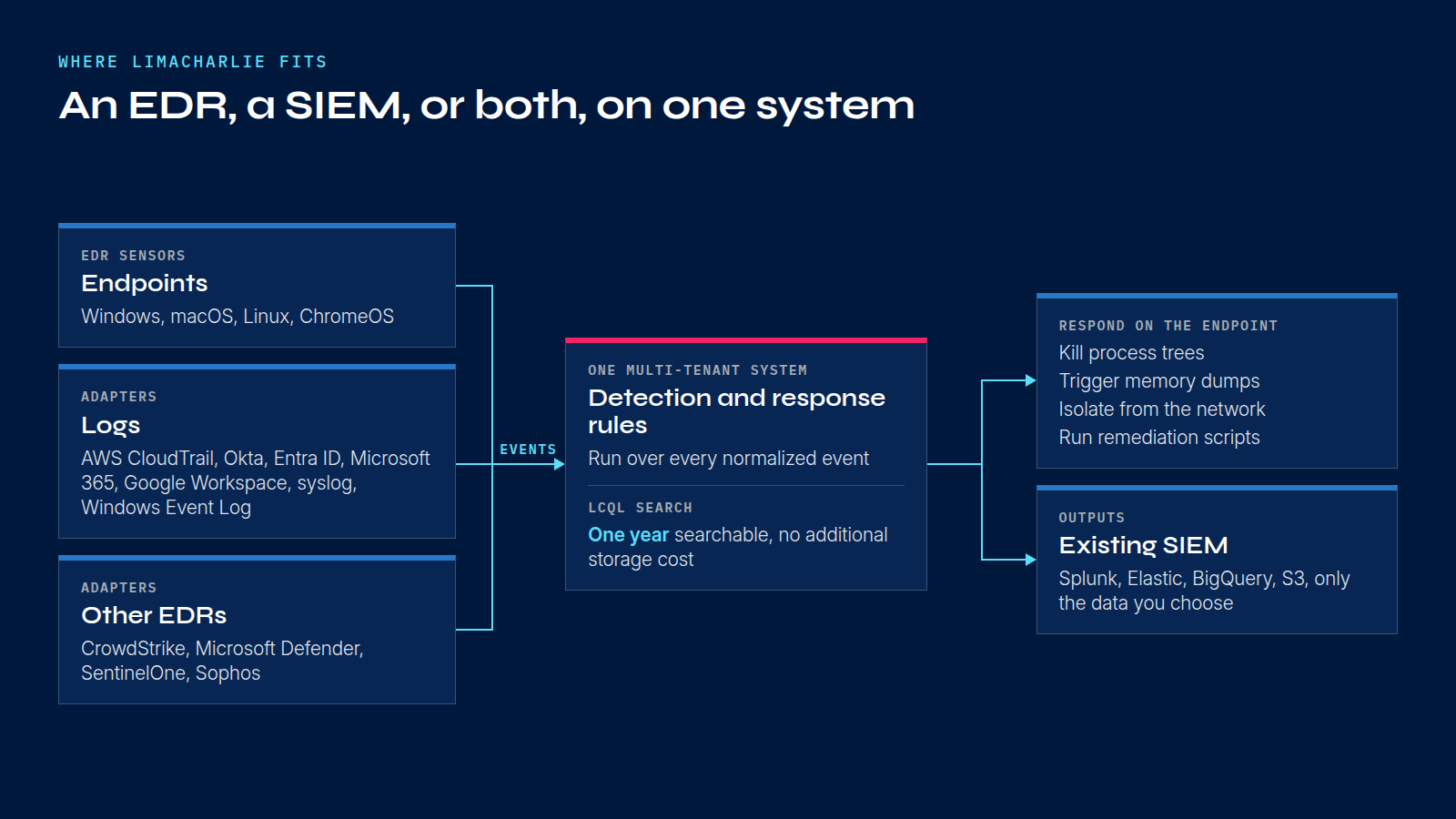
LimaCharlie is cloud-hosted security operations infrastructure that serves as an EDR, a SIEM, or both. It can also be deployed as an XDR, because the same detection and response rules run over endpoint telemetry and the log, identity, cloud and other-EDR data that adapters bring in. Its EDR sensors run on Windows, macOS, Linux and ChromeOS and can kill process trees, trigger memory dumps, isolate endpoints from the network, and run remediation scripts.
On the SIEM side, adapters turn logs from sources such as AWS CloudTrail, Okta, Microsoft Entra ID, Microsoft 365, Google Workspace, syslog and Windows Event Log into normalized LimaCharlie events. Every log becomes an event, the same as sensor telemetry, on one multi-tenant system where detection and response rules and LCQL search run over it. Everything ingested stays searchable for one year at no additional storage cost.
Adapters also read other EDRs, including CrowdStrike, Microsoft Defender, SentinelOne and Sophos, so LimaCharlie can run its detection engine over an existing EDR's telemetry. Outputs stream events to Splunk, Elastic, BigQuery, S3 and others, which lets LimaCharlie run as a parallel pipeline alongside an existing SIEM and send it only the data you choose.
The diagram below shows that path, from sources through one set of rules to response and outputs.
All of it runs from a web console, an API, or AI agents. Billing is by usage: per endpoint for EDR and per GB for telemetry sources, month to month with no contract. Current rates are on the pricing page. LimaCharlie is built for MSSPs and MDR providers.
Where LimaCharlie does not fit
You need hundreds of prebuilt connectors on day one. LimaCharlie's adapter documentation lists dozens of adapter types; Sentinel lists 500+ and Elastic 400+.
You want detections fully packaged. LimaCharlie rules are YAML you write or enable, including Sigma and other managed rulesets, so someone on your team owns detection content.
You already run Microsoft Defender. Microsoft says that with Sentinel in the Defender portal, Defender data is integrated by default.
If the fit looks right, the quickest check is your own data. Try LimaCharlie free today. Just sign up for the free tier on our website.
440 N Barranca Ave #5258
Covina, CA 91723
5307 Victoria Drive #566
Vancouver, BC V5P 3V6
Stay up-to-date on all things LimaCharlie with our monthly newsletter.
This site is protected by reCAPTCHA and the Google Privacy Policy and Terms of Service apply.