How to send CrowdStrike or Defender telemetry to a cheaper data store for detection and hunting

Co-founder and CCO
To send CrowdStrike or Defender telemetry to a cheaper data store, start with the vendor's own export: Falcon Data Replicator (FDR) for CrowdStrike, which you read through an AWS SQS queue URL provided by the Falcon console, and the Defender XDR streaming API, which forwards Advanced Hunting tables to Azure Event Hubs or an Azure Storage account. From there you either land the data in storage you own and query it in place (Amazon S3 with Athena, Amazon Security Lake), archive it into Azure Data Explorer as a 2024 Microsoft Tech Community guide describes, shape it in a pipeline such as Cribl Stream, or ingest it into a system that keeps it searchable, such as Splunk, Datadog, Microsoft Sentinel data lake or LimaCharlie.
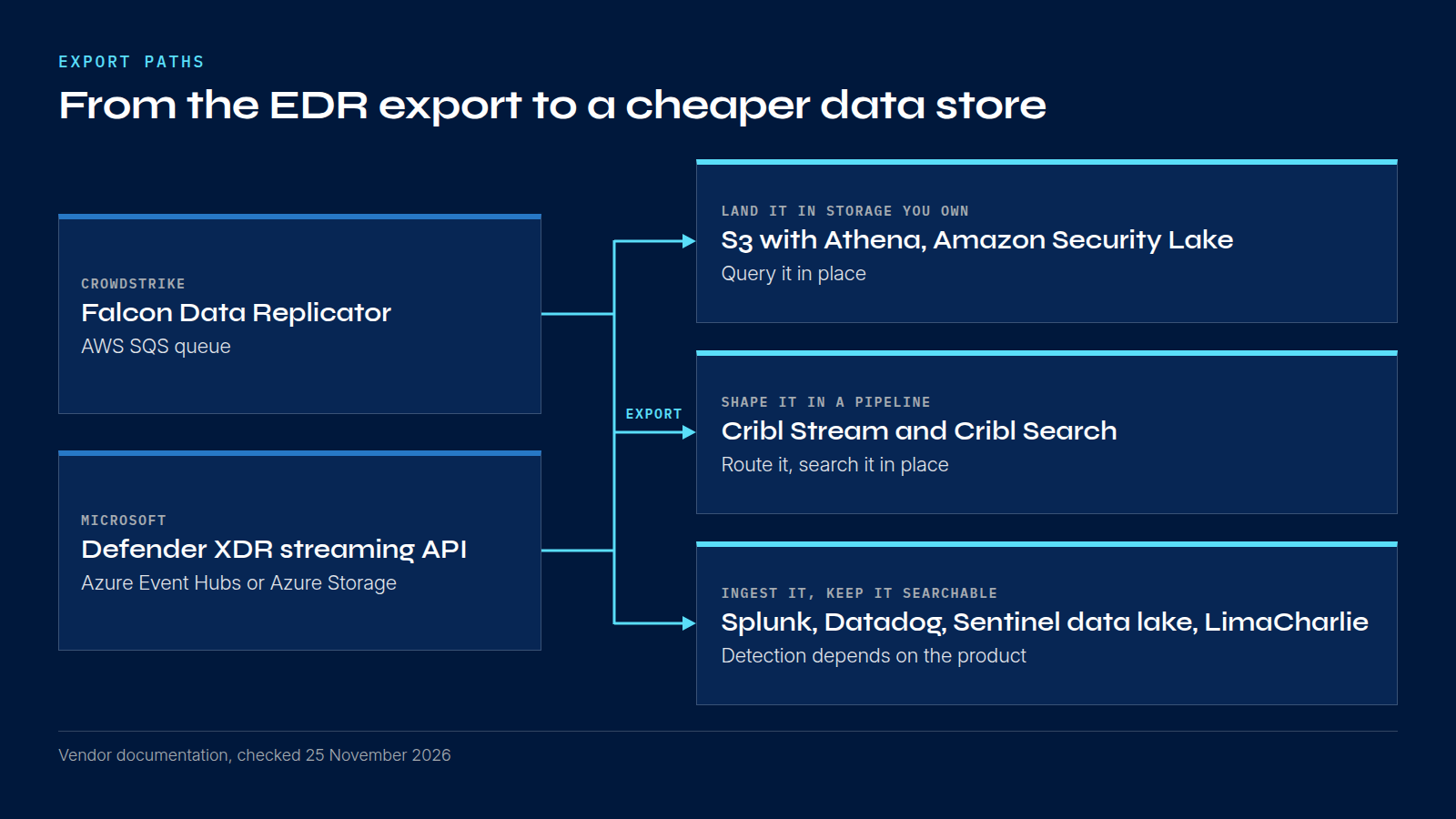
The right choice depends on what you need from the cheaper store: archive and occasional search, or detection rules and hunting on a year of endpoint data. Every vendor fact below comes from that vendor's own site or documentation, checked on 25 November 2026.
Step one: get the telemetry out of the EDR
CrowdStrike Falcon Data Replicator
CrowdStrike's FDR repository describes FDR as replicating "log data from your CrowdStrike environment to a stand-alone target," either a file system or a cloud storage bucket. You get AWS credentials and an SQS queue URL from the Falcon console, and the sample script copies events to local disk or your own S3 bucket, with an option to convert events to the OCSF format. The README notes that AWS is the only cloud provider implemented.
If you plan to stay inside CrowdStrike, its SIEM product page states that data from licensed Falcon modules is available there "without additional ingestion charges."
Microsoft Defender XDR streaming API
Microsoft documents the Defender XDR streaming API as the way to stream Advanced Hunting events "to Azure Event Hubs for downstream processing, integration, and long-term storage." You can send everything to one Event Hub or each table to its own, or forward to Azure Storage, where each event type gets its own blob container of JSON rows. The supported event types include DeviceProcessEvents, DeviceNetworkEvents, DeviceFileEvents, DeviceRegistryEvents and DeviceLogonEvents. Setup needs a Contributor role on the destination (Event Hubs, Azure Storage).
Where to send CrowdStrike or Defender telemetry for detection and hunting
Option | What it is good at | Using the stored data |
|---|---|---|
Amazon S3 with Athena, or Amazon Security Lake | ||
Azure Data Explorer | Long-term Defender archive, per a 2024 Microsoft Tech Community guide | Queries on real-time and historical data, per the same 2024 guide |
Cribl Stream and Search | ||
Splunk | "Retention and further analysis," CIM-compatible for other Splunk apps | |
Datadog Flex Logs | ||
Microsoft Sentinel data lake | Data only in the data lake isn't available in advanced hunting | |
LimaCharlie | Ingest Defender or Falcon events, a year searchable, D&R rules | D&R rules on ingested events, LCQL hunting |
S3, Security Lake and Azure Data Explorer
Amazon Security Lake is backed by S3 buckets you own, converts data from natively supported AWS services to Apache Parquet and OCSF, and accepts custom sources. You query it with Athena, Redshift or a subscriber tool. Athena charges "based on data processed or compute used," on top of standard S3 storage rates. On the Microsoft side, a 2024 Microsoft Tech Community guide walks through Defender to Event Hubs to Azure Data Explorer, written for teams that "don't use Sentinel" or want more processing, and calls archiving "substantial savings" against long-term Log Analytics storage.
Cribl
Cribl's FDR integration brief shows Cribl Stream reading the FDR S3 bucket through its SQS queue, then routing "high-value events to your SIEM or SOAR, full-fidelity data to a security data lake, and long-term archives to low-cost storage." Replay sends archived data back into an analytics tool when needed. Cribl Search queries data in place, including Amazon Security Lake and S3, using a KQL-based language, and can schedule searches and turn the results into alerts. The FDR brief also pitches sending only the data you need for detection, investigation and advanced threat hunting to SIEM and SOAR platforms to "control ingest costs." See /vs/cribl for how LimaCharlie compares.
Splunk and Datadog
The Splunk Add-on for CrowdStrike FDR pulls FDR events from the provisioned S3 bucket, using SQS to scale out, into your own Splunk instance "for retention and further analysis." Datadog says Flex Logs provides "cost-effective, long-term retention" of logs by decoupling storage from compute costs, and names security logs as one example of logs that need long retention but sometimes need to be queried urgently. Flex Logs Starter stores logs for 3, 6, 12 or 15 months, and the scalable compute options store them for 30 to 450 days. Datadog lists "Need all logs for security investigations" among its example use cases, and notes that monitors are not supported in Flex Logs. Our /vs/splunk page covers Splunk in more depth.
Microsoft Sentinel data lake
The Sentinel data lake is built for "cost effective retention of large volumes of security data for up to 12 years" and works with all Microsoft Defender data sources. Microsoft's advanced hunting overview notes that data stored only in the data lake isn't available in advanced hunting and says to "use data lake exploration to query that data." The data lake overview adds that "data in the analytics tier is mirrored to the lake tier, preserving a single copy of the data."
Where LimaCharlie fits
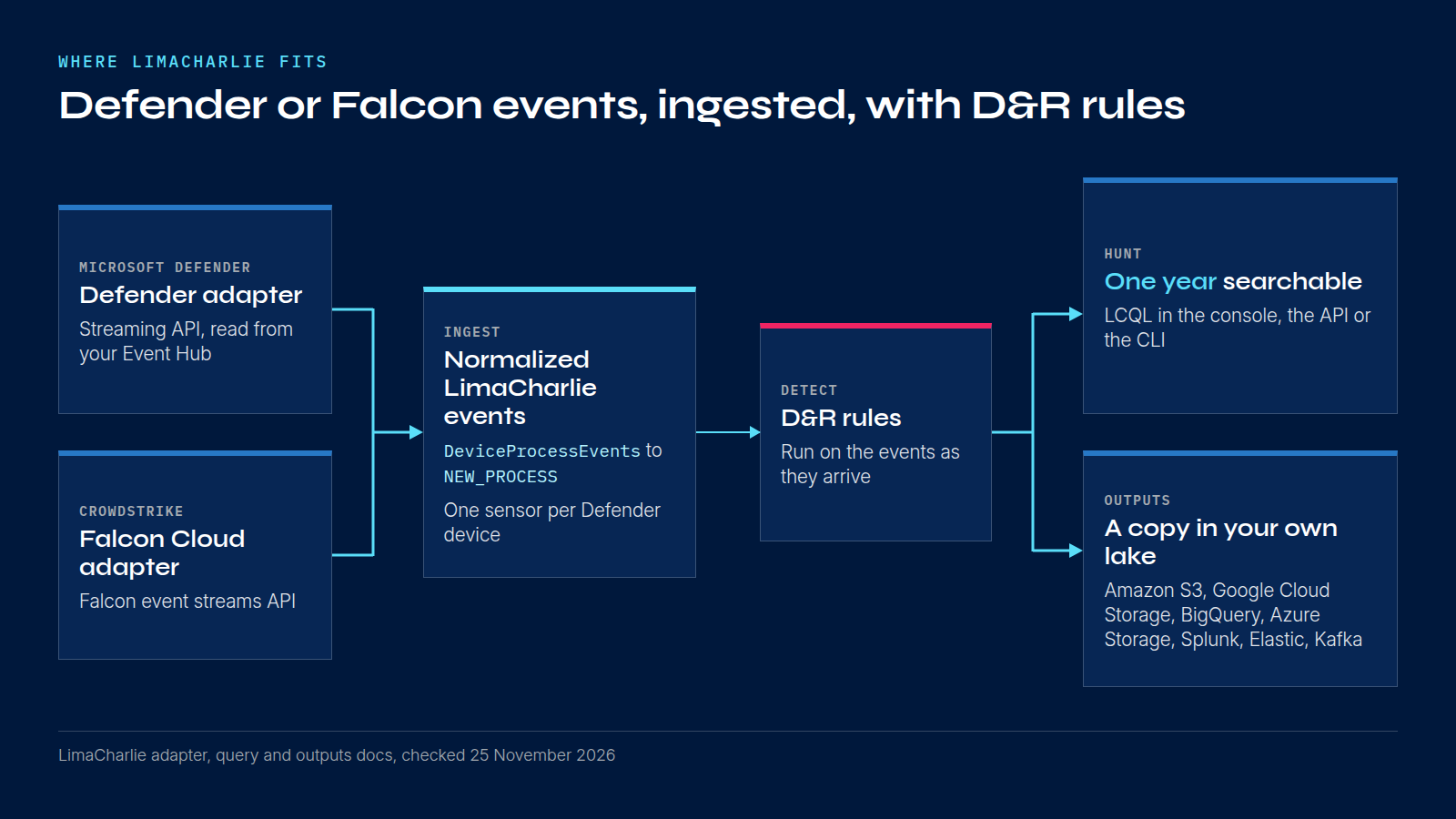
LimaCharlie is cloud-hosted security operations infrastructure that serves as an EDR, a SIEM, or both: endpoint sensors, log ingestion, and detection and response rules on one multi-tenant system (limacharlie.io). Telemetry from an existing EDR such as CrowdStrike or Microsoft Defender arrives through adapters, which turn external logs into normalized LimaCharlie events (adapter docs).
For Defender, the Microsoft Defender adapter reads the streaming API from your Event Hub. It receives raw telemetry tables such as DeviceProcessEvents and DeviceNetworkEvents and maps them to native LimaCharlie event types like NEW_PROCESS, with one sensor per Defender device. The docs describe this path as providing "full endpoint telemetry for custom detection rules and threat hunting." A second option polls Microsoft Graph for Defender alerts only.
For CrowdStrike, the Falcon Cloud adapter connects with an API client that has the Event streams read scope and, in the words of LimaCharlie's adapter docs, streams events "as they happen in the CrowdStrike Falcon Console."
Once ingested, the data works like any other LimaCharlie telemetry:
Adapter data is billed per GB ingested and includes one year of retention (billing docs). Current rates are on the pricing page.
You hunt across that year with the LimaCharlie Query Language (LCQL) in the console, the API or the LimaCharlie CLI (query docs).
Detection and response rules (D&R rules) run on the events as they arrive, and Replay runs D&R rules against historical traffic, billed per event evaluated.
Outputs stream events onward to Amazon S3, Google Cloud Storage, BigQuery, Azure Storage, Splunk, Elastic or Kafka if you also want a copy in your own lake.
Where LimaCharlie does not fit
Raw FDR data: LimaCharlie's docs do not describe an FDR integration. The CrowdStrike adapter uses the Falcon event streams API; it timestamps events when it receives them and drops events from adapter downtime unless you set a start point. If you need the full FDR feed, Cribl, the Splunk add-on and CrowdStrike's own FDR script are documented routes.
Retention past a year: the year is included, but for multi-year archives you stream events to storage you own or use a product with longer tiers, such as Sentinel data lake.
Unmetered search: queries are charged by the amount of data churned (query console docs), so a hunt across twelve months costs more than one across a day.
Questions to settle before you choose
How many days of raw events your current EDR console keeps.
Whether you need detection rules on the cheaper store, or only search during an investigation.
Whether recent and older data share one query language and one console.
What a year-long hunt costs in each option: storage, scans and compute together.
The pricing page lists a free Community Edition with one year of storage, which is enough to test the Defender path on your own data. Try LimaCharlie free today. Just sign up for the free tier on our website.
440 N Barranca Ave #5258
Covina, CA 91723
5307 Victoria Drive #566
Vancouver, BC V5P 3V6
Stay up-to-date on all things LimaCharlie with our monthly newsletter.
This site is protected by reCAPTCHA and the Google Privacy Policy and Terms of Service apply.