The best commercial alternatives to Wazuh

Co-founder and CCO
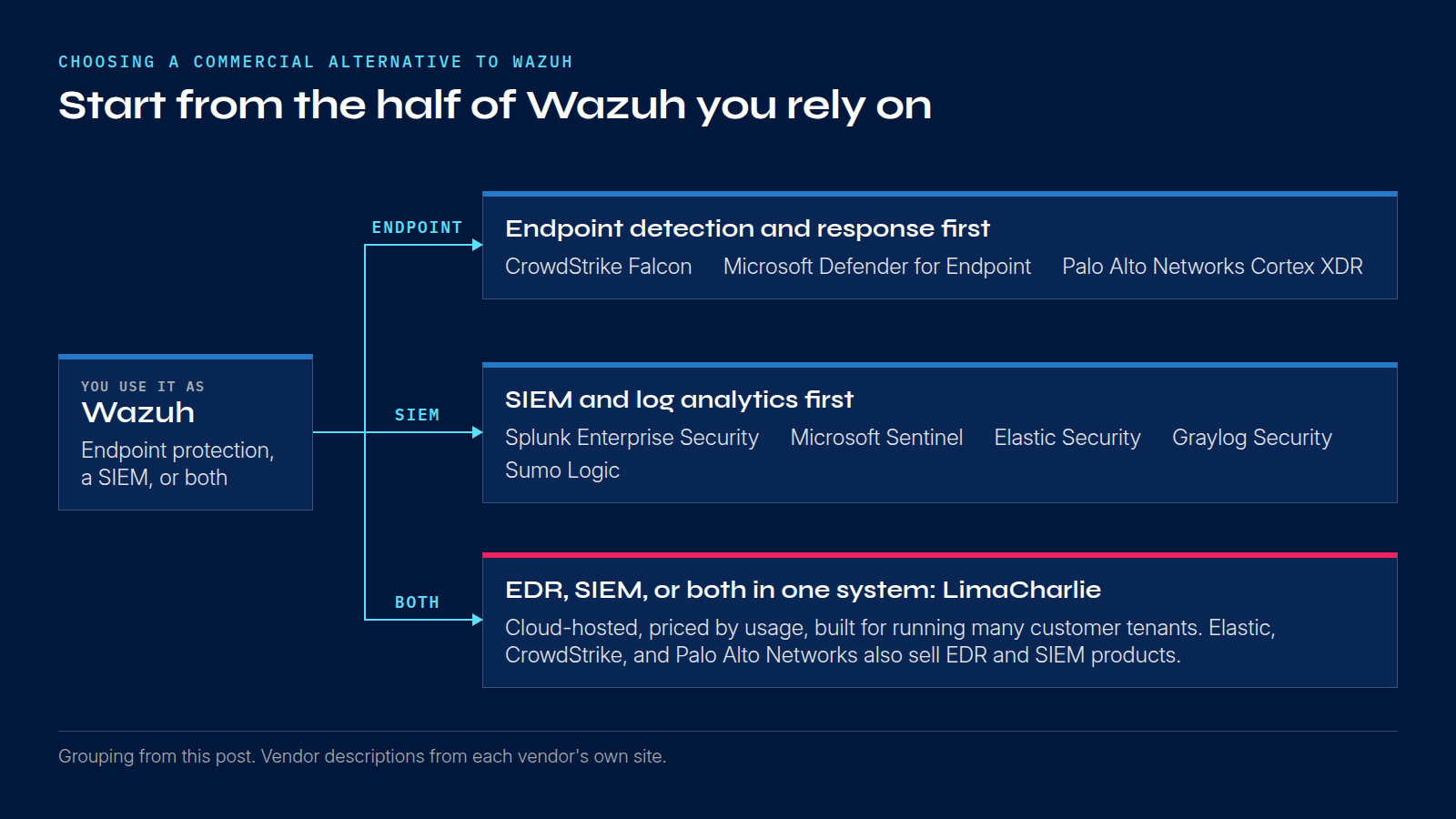
The best commercial alternatives to Wazuh depend on which half of Wazuh you rely on: endpoint protection, the SIEM, or both in one system, which is where LimaCharlie fits. If you use it mainly as endpoint protection, look at CrowdStrike Falcon, Microsoft Defender for Endpoint, or Palo Alto Networks Cortex XDR; if you use it mainly as a SIEM, look at Splunk Enterprise Security, Microsoft Sentinel, Elastic Security, Graylog Security, or Sumo Logic. If you want both in one cloud-hosted system, priced by usage and built for running many customer tenants, look at LimaCharlie. Some vendors above also sell both halves: Elastic Security includes SIEM, XDR and endpoint protection, and automation on one platform, the CrowdStrike Falcon platform includes Next-Gen SIEM, and Palo Alto Networks says Cortex XSIAM "replaces traditional SIEM."
This post compares those commercial alternatives to Wazuh on facts you can check on each vendor's own site, then says where LimaCharlie fits and where it does not.
What you are replacing
Wazuh describes itself as "Unified XDR and SIEM protection for endpoints and cloud workloads". The Wazuh homepage lists file integrity monitoring, log data analysis, vulnerability detection, and regulatory compliance among its capabilities.
The Wazuh architecture is a multi-platform Wazuh agent, deployed on endpoints to collect and forward security data, and three central components: the Wazuh server, the Wazuh indexer, and the Wazuh dashboard. Before you switch vendors, note that Wazuh sells commercial services of its own, including Wazuh Cloud, a hosted service with a 14-day free trial, and support services with a Standard plan covering business hours (8/5) and a Premium plan that is 24/7 for critical issues. If the software suits you and only the operations burden is the problem, those may be enough.
The best commercial alternatives to Wazuh, by what you need
Endpoint detection and response first
CrowdStrike Falcon runs on a "single lightweight sensor" that "captures high-fidelity telemetry across domains." The Falcon platform also includes Next-Gen SIEM, and CrowdStrike sells Falcon Complete, a 24/7 managed detection and response service.
Microsoft Defender for Endpoint is "an enterprise endpoint security platform designed to help organizations prevent, detect, investigate, and respond to advanced threats on their endpoints," and it feeds signals into the unified Microsoft Defender portal.
Palo Alto Networks Cortex XDR "connects data from endpoint, network, cloud, agentic endpoint, identity, and email sources" to detect and prioritize attacks, and Palo Alto says you can extend it with Agentic Endpoint Security, NG-SIEM, Endpoint Data Loss Prevention, Exposure Management, Email Security, and Cloud Security, "all unified within a single sensor on the Cortex Platform". Palo Alto says Cortex XSIAM "replaces traditional SIEM by unifying broad SOC functionality".
SIEM and log analytics first
Splunk Enterprise Security combines SIEM, SOAR, and UEBA; the Essentials Edition includes SIEM and the Premier Edition adds UEBA and SOAR. Splunk's data platform comes as Splunk Cloud Platform, hosted in the cloud, or Splunk Enterprise, deployed on premises, in a private cloud, or hybrid.
Microsoft Sentinel is "a cloud-native SIEM solution" covering detection, investigation, response, and hunting. Microsoft notes that after March 31, 2027 it will be available only in the Microsoft Defender portal.
Elastic Security includes SIEM, XDR and endpoint protection, and automation on one platform, runs across cloud, on-premises, and air-gapped environments, publishes its detection rules openly on GitHub, and is "priced on compute and storage, not per endpoint".
Graylog Security comes from Graylog, which "started in 2009 as an open source log management project" and grew into "a full-featured SIEM on the same codebase". Graylog Open is "free to download and use under the Server Side Public License (SSPL)," and you self-host it on any infrastructure.
Sumo Logic puts "Data pipelines, log analytics, SIEM, and agents on one platform" and offers a 14-day sandbox trial. Its security solutions page lists SOC 2 Type 2 and says it is "FedRAMP® Authorized."
Open XDR with built-in scanning
LevelBlue USM Anywhere is an Open XDR product with "centralized visibility, integrated threat intelligence, automated workflows," and built-in asset scanning and vulnerability assessment.
Where LimaCharlie fits
LimaCharlie is cloud-hosted security operations infrastructure that serves as an EDR, a SIEM, or both, priced by usage and run from a web console, an API, or AI agents. That combination is the overlap with Wazuh: one system covering the endpoint and the logs. LimaCharlie can also be deployed as an XDR, with the same detection and response rules running over endpoint telemetry and the data its adapters bring in.
Here is how Wazuh's capabilities map across:
Wazuh capability | LimaCharlie equivalent |
|---|---|
LimaCharlie sensors for Windows, Linux, macOS, and Chrome | |
Wazuh log data analysis | Adapters for syslog, Windows Event Log, Microsoft 365, AWS CloudTrail, Okta, Entra ID, and others |
Detection and response rules you can save as YAML files, plus managed rulesets from SOC Prime and Soteria | |
Wazuh file integrity monitoring | The Integrity extension for file and registry integrity monitoring |
Wazuh vulnerability detection | Vulnerability reporting from installed package inventory, with CVSS, EPSS, and CISA KEV data |
Wazuh indexer, for indexing and storage | A year of searchable telemetry, hosted by LimaCharlie |
The clearest difference from a self-hosted Wazuh deployment is where the data lives: LimaCharlie is cloud-hosted, while a self-hosted Wazuh deployment forwards analyzed data to a Wazuh indexer for indexing and storage. LimaCharlie is built for MSSPs and MDR providers, and it is multi-tenant: each customer environment is its own organization, AI operators access every platform capability programmatically, across every client environment, and all invoices for a billing domain can be aggregated into a single monthly invoice. People run it from the web console, the LimaCharlie CLI, or the API, and AI agents operate it through the same CLI.
It also runs alongside tools you already have. Adapters ingest logs from security tools including CrowdStrike, SentinelOne, and Microsoft Defender, and outputs stream telemetry to Splunk, Elastic, OpenSearch, Kafka, S3, and other destinations. You can use LimaCharlie alongside existing tools or as a replacement as contracts expire.
Billing is usage-based and month-to-month with no contract, and there is a free Community Edition. Current figures are on the pricing page. For a direct comparison, see LimaCharlie vs Wazuh, and for the EDR and SIEM vendors above, vs CrowdStrike, vs Splunk, and vs Elastic.
Where LimaCharlie does not fit
You must run everything on your own hardware. LimaCharlie is not available on premises, and its sensors connect to the cloud. Wazuh's central components can be installed on a single server or on separate servers. Elastic, Graylog Open, and Splunk Enterprise can be self-managed, and Elastic and Graylog both describe air-gapped deployments.
You are committed to one vendor's suite. If your endpoints already run Microsoft Defender for Endpoint, it feeds signals into the unified Microsoft Defender portal, and Microsoft says Sentinel will be available only in that portal after March 31, 2027, where you can already use it "even if you aren't using other Microsoft Defender services".
You have no software budget. Wazuh has no license cost. LimaCharlie has a free Community Edition and bills by usage beyond it.
How to test the shortlist
Pick the two or three options that match the half of Wazuh you use most. Deploy each on a small set of the same endpoints, send the same log sources, and port a handful of your existing Wazuh rules. Compare detection coverage, search speed across your retention window, and the bill after a month of your own data.
Try LimaCharlie free today. Just sign up for the free tier on our website.
440 N Barranca Ave #5258
Covina, CA 91723
5307 Victoria Drive #566
Vancouver, BC V5P 3V6
Stay up-to-date on all things LimaCharlie with our monthly newsletter.
This site is protected by reCAPTCHA and the Google Privacy Policy and Terms of Service apply.