Claude Code Cuts SOC Setup to 10 Minutes

Sr. Technical Content Strategist
Security teams accept that standing up a real SOC requires days of configuration, credential wrangling, and infrastructure work before any actual security engineering begins. With LimaCharlie, actual setup time is closer to ten minutes.
It gives valuable time back to SecOps teams by managing infrastructure and simplifying onboarding and operations with Claude Code. Using agentic AI to deploy SOC capabilities means your team spends less time on infrastructure and more on security work.
A platform built for flexibility
The first step toward agentic operations is getting a free account set up in LimaCharlie. Setting up an organization only takes an email address and a couple of minutes. Simply choose where your data resides, name your organization, and select a sensor to deploy on an endpoint.
With three quick selections the core infrastructure of your SOC is in place and ready for refinement.
LimaCharlie’s Agentic SecOps Workspace is designed to seamlessly scale and offers open API integration to adapt to your specific environmental needs: whether classroom labs, SOC teams, businesses, or MSSPs who need multi-tenant flexibility without enterprise pricing.
Claude Code as your operator
Integrating Claude Code is what makes everything after account creation fast. The LimaCharlie Claude Code plugin is installed with two short commands. Once Claude Code integrates with LimaCharlie you have a SOC that can be built, structured and controlled through conversational prompts.
Instead of navigating dashboards, hunting through documentation, or constructing API calls, you describe what you want in plain language and Claude handles the operational details. The authentication, the plugin architecture, and the initialization process are all lightweight enough to complete in under ten minutes.
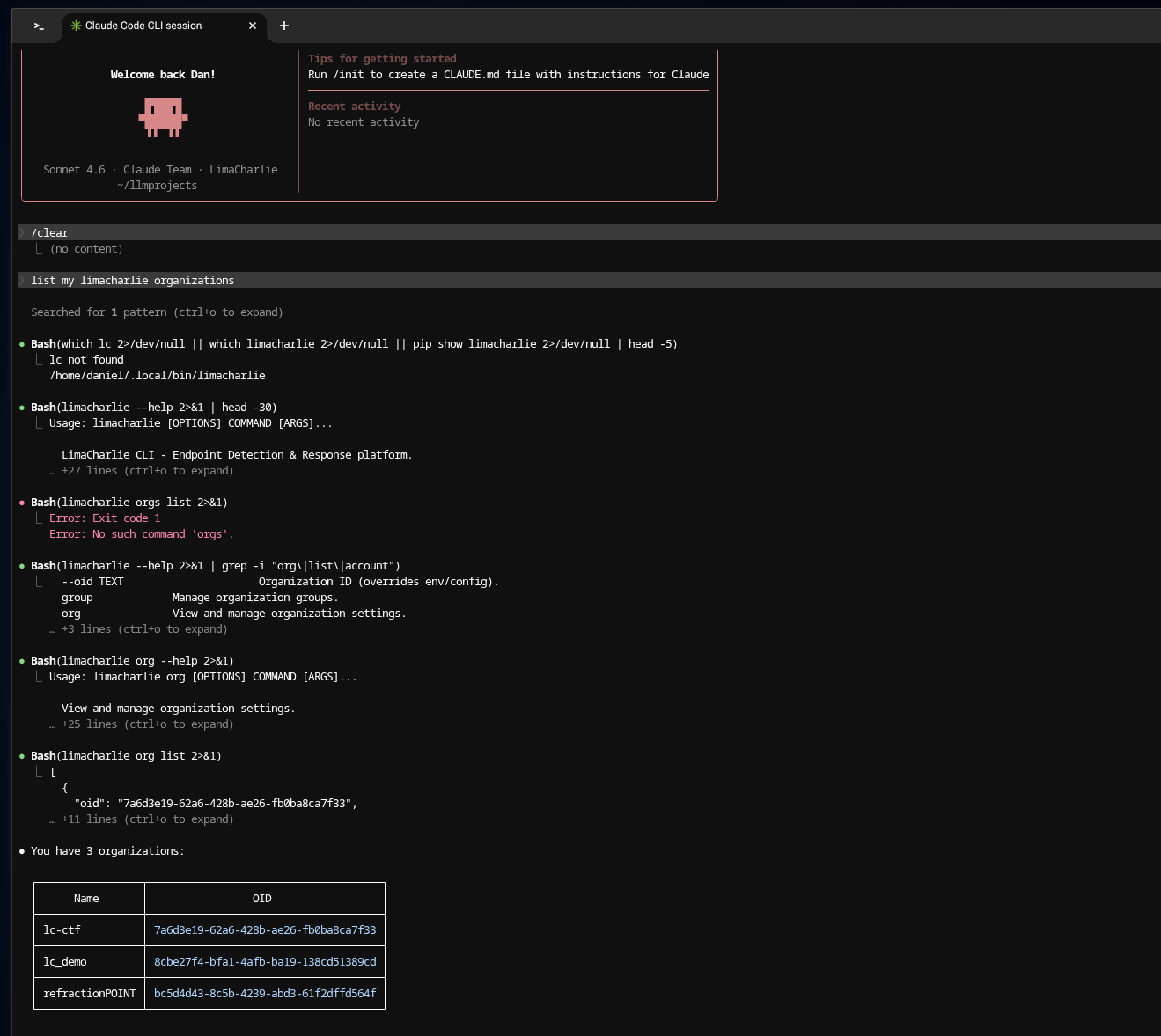
Deploying infrastructure with a prompt
Sensor deployment demonstrates the considerable efficiency difference between manual and agentic setup. Manually creating a sensor is a three-step process:
Create an installation key
Download the correct binary for the endpoint's operating system
Run the installer
With Claude Code integrated, you can simply describe the outcome you want. For example, if you want to create a new organization and deploy a sensor, type:
“Create a new org called MyNewOrg and install a sensor on this system. Verify it is connected to limacharlie. Make sure you create an install key and do not use the json key as the install key”
A few minutes later you will have a new org, a sensor installed on the local machine, and verification of the connection. Claude works through the steps, requests your approval on each action, and confirms that the sensor is live.
A process that used to involve several distinct trips through the UI collapses into a single conversational exchange.
Why This Approach Matters
Removing friction from infrastructure setup lets SecOps professionals spend their time on security problems rather than infrastructure ones. However, Claude Code is not limited to only doing infrastructure work. It can also translate community detection rules into LimaCharlie's detection and response format, generate new detections from threat intelligence, and tune rules to reduce noise.
Adding Claude Code as the interface makes it accessible in a new way: not just to enterprise teams with dedicated platform engineers, but to anyone who can describe what they want in a sentence. The same interface that deployed your first sensor can also handle detection engineering, rule tuning, multi-tenant management, and other SOC tasks.
Set up security operations in ten minutes for free at limacharlie.io.
440 N Barranca Ave #5258
Covina, CA 91723
5307 Victoria Drive #566
Vancouver, BC V5P 3V6
Stay up-to-date on all things LimaCharlie with our monthly newsletter.
This site is protected by reCAPTCHA and the Google Privacy Policy and Terms of Service apply.