Choosing the best SIEM for MSSPs managing many small clients

Co-founder and CCO
The best SIEM for an MSSP managing many small clients is either a managed service where the vendor's analysts watch the alerts, such as Huntress or Arctic Wolf, or a system you operate yourself for many clients, such as LimaCharlie, Microsoft Sentinel, or Elastic. Either way it should keep each client in its own tenant, let you change every tenant from one place, and charge in a unit a small client's budget can carry. The managed services include Huntress, Blackpoint Cyber, Arctic Wolf, ConnectWise with its Managed SIEM option, Kaseya, and N-able. The systems you operate yourself include Microsoft Sentinel, Elastic, Wazuh, Graylog, Sumo Logic, Securonix, Rapid7 InsightIDR, ManageEngine Log360 MSSP, and LimaCharlie.
No vendor is the right answer for every MSSP, so the post ends with a short way to choose.
What a SIEM for MSSPs managing many small clients needs
Small clients change the arithmetic. Each one brings a little data and a small budget, and there are many of them, so per-client overhead decides your margin. Four things carry most of that overhead:
Tenant separation: each client's data, rules, and users stay apart, and you can show the client that they do.
Central change: one rule fix or new log source reaches every tenant without logging in to each one.
Pricing unit: per GB, per user, per data source, or per endpoint. The unit that fits depends on whether your small clients are log-heavy or endpoint-heavy.
Retention: how long data stays searchable, and whether that period is included or extra.
Managed SIEM and MDR services with the vendor's own SOC
These suit an MSP that wants to resell detection and response without staffing analysts around the clock.
Huntress Managed SIEM includes Huntress's 24/7 SOC, detection tuning, compliance reporting, and onboarding in the price. It is priced per data source, and overage charges can apply if pooled volume goes over 10 GB per source.
Blackpoint Cyber staffs its SOC 24/7/365, is channel-first and does not sell directly to the SMB clients its partners serve, and lets partners work month to month. SIEM with 365 days of log storage is part of its Standard package.
Arctic Wolf Aurora MDR Connect is a tier of Arctic Wolf's managed detection and response (MDR) service that provides Arctic Wolf security operations to MSPs without requiring them to maintain their own SOC. Arctic Wolf operates the SOC on the partner's behalf, 90 days of log retention is included, and Arctic Wolf's MSP Portal is a centralized multi-tenant interface for checking the status of all customer organizations, managing tasks, downloading reports, and managing user access.
ConnectWise SIEM offers per-user pricing and a Dedicated Tenant tier with segmented storage, memory, and compute. Its Managed SIEM option adds 24/7 SOC support, included in Dedicated Tenant and available for Essentials and Pro to cover all clients or just a few.
Kaseya SIEM is co-managed, with Kaseya analysts monitoring 24/7, user-based pricing, and 400 days of searchable log retention.
N-able Adlumin is a cloud SIEM with unmetered data ingest, and its MDR service sends investigated incidents with evidence and guidance.
SIEMs you operate yourself
These suit an MSSP that writes its own detections and runs its own analysts.
Microsoft Sentinel lets an MSSP manage customers' Sentinel resources from its own Azure tenant through Azure Lighthouse. It bills per GB, retains ingested data at no charge for the first 90 days, and ingests some Microsoft sources, such as Office 365 audit logs, at no charge. For clients who live in Microsoft 365, that last point is a strong argument.
Elastic Security separates clients with Kibana Spaces and role-based access, runs in the cloud, on premises, or both, and for larger deployments uses cross-cluster search to query dedicated client environments from one place. Serverless Security bills per GB ingested and retained.
Wazuh is free and open source. On the Platinum partner plan, Wazuh offers a centralized console for multi-tenancy and authorizes the eligible partner to white-label the web interface for customers with a valid contract. Wazuh Cloud is a hosted option with Small, Medium, Large, and Custom tiers. Small covers up to 100 active agents with 1 month of indexed data retention and 3 months of archive retention, Medium and Large cover up to 250 and 500 agents with 3 months indexed and 1 year archived, and all three list the Standard support plan.
Graylog says it can serve multiple clients across cloud, on-prem, or hybrid deployments, with the same features in each, and its data lake stores logs without counting against the license.
Sumo Logic documents that MSSPs often consist of a parent organization with child organizations that use Cloud SIEM, and its Flex package bills search separately, with an estimated price per TB of data scanned when a query runs.
Securonix says its Unified Defense SIEM helps MSSPs deliver stronger outcomes across every tenant, and that its platform is designed around analytics-first detection.
Rapid7 InsightIDR lets an MSSP search and act on every customer's investigations from a single view, with each customer on its own linked license. Log data is stored for 13 months on the standard subscription.
ManageEngine Log360 MSSP isolates each client's data and manages clients from one console.
Where LimaCharlie fits
LimaCharlie is security infrastructure that gives you the parts: sensors, log intake, a detection engine, storage and search, and response. It belongs in the second group: you run the SOC, and LimaCharlie sells to you as the provider, so you own the client relationship and decide what goes into each offering.
For many small clients, the parts that line up with the four needs above are these:
One organization per client. Each client is an isolated tenant with its own sensors, data, rules, and billing, and your staff reach every tenant through Organization Groups.
One Git template for every tenant. Detection and response rules, false-positive rules, outputs, adapters, and AI agents are YAML records. Git Sync applies a change in each tenant that includes the file, so a rule fixed once in a shared folder reaches every client.
A year of searchable retention included. Endpoint telemetry and log data from adapters both come with a year of retention.
Logs and endpoints on the same rules. Adapters bring in syslog, Microsoft 365, Entra ID, Okta, AWS CloudTrail, and telemetry from an EDR the client already runs, and the same detection and response rules run on all of it as events arrive.
Usage-based billing on one invoice. Endpoints, adapter data, and search are metered separately, and Unified Billing rolls every client organization into one monthly invoice. Current rates are on the pricing page, and there is a free Community Edition to test with.
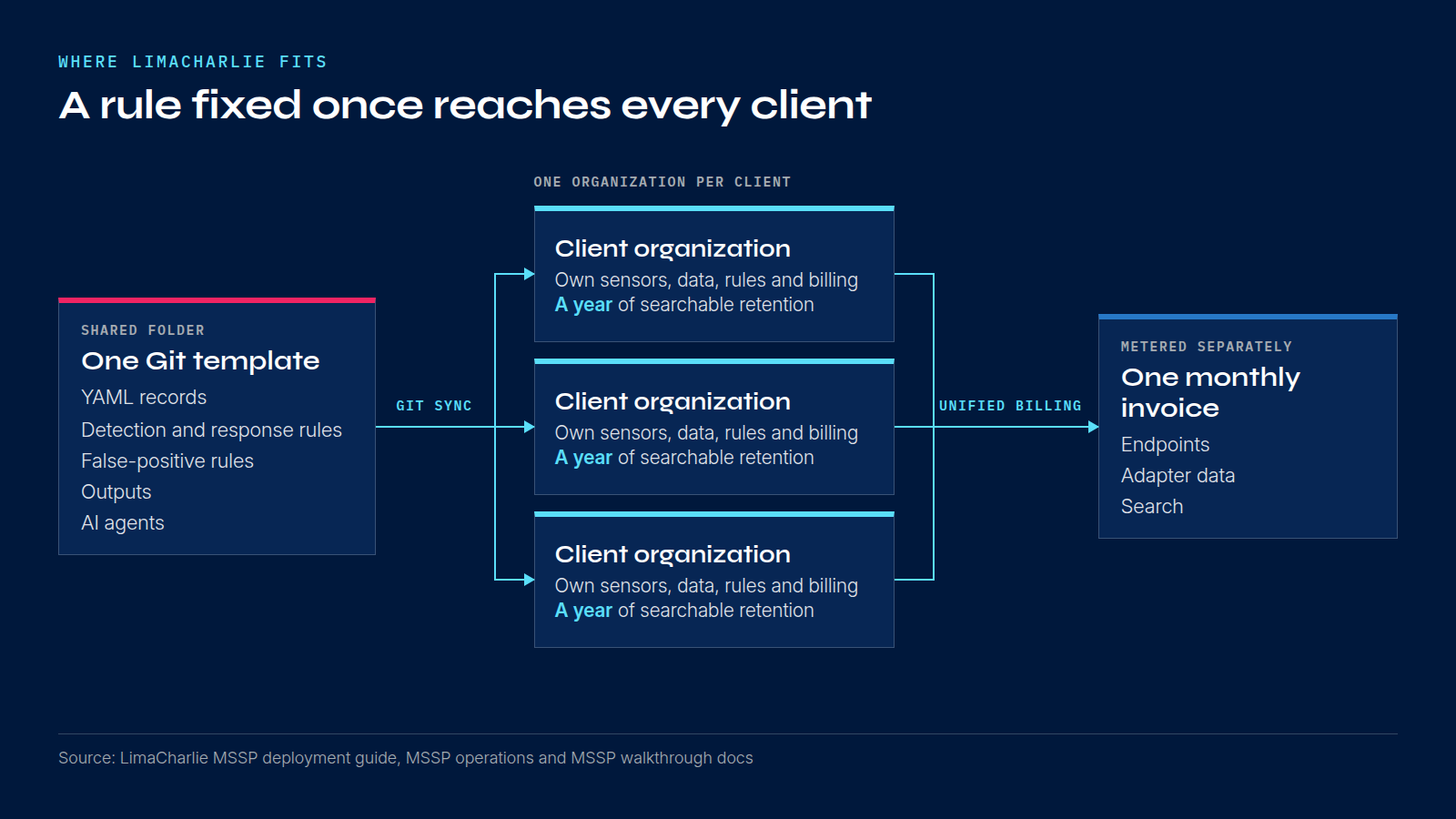
AI agents operate the same tenants through the LimaCharlie CLI and API, so an agent can triage the case queue, or open a pull request with a rule change that Git Sync rolls out to each client after your team reviews and merges it, with a budget cap you set on each agent.
Black Hills Information Security, an MSSP on LimaCharlie, cut its cost per endpoint in half.
If you are comparing LimaCharlie with a specific option above, see LimaCharlie vs Wazuh, LimaCharlie vs Elastic Security, and LimaCharlie vs Splunk.
Where LimaCharlie is a poor fit
You want analysts included. LimaCharlie is infrastructure: it sells to you, the provider, and gives you the parts, and you decide how they add up to a service. If you want the vendor's analysts on the alerts, look at the first group. Huntress, Blackpoint Cyber, Kaseya, and ConnectWise through its Managed SIEM option put analysts on alerts 24/7, Arctic Wolf operates the SOC on the partner's behalf, and N-able's MDR service sends investigated incidents with evidence and guidance.
Every client is Microsoft-only. If all your small clients run Microsoft 365 and Defender, price out Sentinel and its Lighthouse access first. Office 365 audit logs and Defender alerts ingest at no charge, though raw logs for some Defender and Entra ID data types are paid.
How to choose
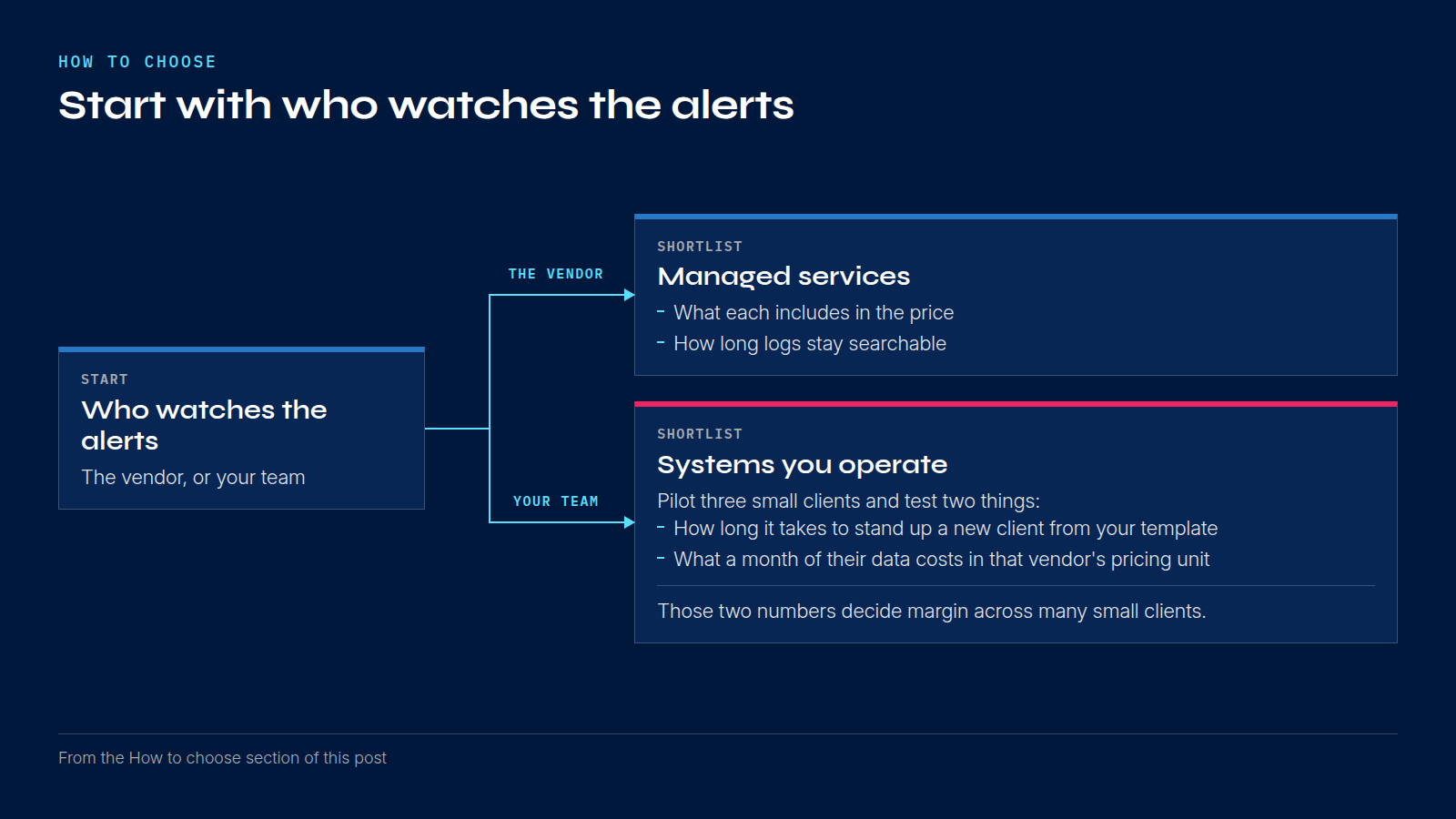
Start with who watches the alerts. If it is the vendor, shortlist the managed services and compare what each includes in the price and how long logs stay searchable. If it is your team, shortlist the systems you operate, and test two things with a pilot of three small clients: how long it takes to stand up a new client from your template, and what a month of their data costs in that vendor's pricing unit. Those two numbers decide margin across many small clients more than any feature list.
Try LimaCharlie free today. Just sign up for the free tier on our website.
440 N Barranca Ave #5258
Covina, CA 91723
5307 Victoria Drive #566
Vancouver, BC V5P 3V6
Stay up-to-date on all things LimaCharlie with our monthly newsletter.
This site is protected by reCAPTCHA and the Google Privacy Policy and Terms of Service apply.