The best EDR with a full API for automation: seven options compared

Co-founder and CCO

The best EDR with a full API for automation depends on how you plan to automate: CrowdStrike Falcon, Microsoft Defender for Endpoint, Palo Alto Networks Cortex XDR, Elastic Security, Huntress Managed EDR and LimaCharlie all publish APIs. SentinelOne's Purple AI MCP Server signs in with a SentinelOne Console token from a Service User with access to a single Account or Site. Their documented rate limits differ: 60 requests per minute for a Huntress API account, and 500 requests per 60 seconds for a LimaCharlie API key. CrowdStrike documents hundreds of API operations with SDKs in six languages, the Microsoft Graph security API pulls incidents and alerts from services that are part of or integrated with Microsoft 365 Defender, SentinelOne's Singularity Hyperautomation automates response workflows in a no-code interface, and Huntress pairs its API with a managed SOC. In LimaCharlie, the API covers every platform capability, and detection and response rules can run automation on each event as it arrives.
This post compares the options on facts you can check in each vendor's documentation, then says where LimaCharlie fits and where another product is the better choice.
What a full API for automation means in an EDR
An EDR API earns the word "full" when a script can do everything an analyst does in the console. Four things show it in practice:
Coverage: host inventory, alerts, hunting queries, response actions (isolate, kill, collect) and configuration such as rules and exclusions are all reachable from the API.
Limits: the documented rate limits and query quotas decide whether automation can run across thousands of hosts or many tenants.
Tooling: SDKs, a CLI and configuration as code save you from writing an HTTP client and a deployment pipeline yourself.
Where automation runs: some products start automation from inside the detection engine, others expect an external SOAR tool or your own code to poll the API.
The best EDR with a full API for automation, by vendor
CrowdStrike Falcon
The CrowdStrike Falcon API is organized by domain, from hosts and alerts to cloud security and MSSP (Flight Control) operations, and its Real-Time Response domain executes commands on live endpoints, runs scripts and contains compromised hosts. CrowdStrike publishes SDKs for Python, Go, PowerShell, JavaScript, Rust and Ruby, plus Terraform for managing Falcon platform resources as configuration as code, and the Falcon MCP server for AI assistants. FalconPy, the Python SDK, offers a single class that reaches every operation in every service collection. It suits large teams who want a broad documented surface and SDKs in their own language. See LimaCharlie vs CrowdStrike for a side-by-side comparison.
Microsoft Defender for Endpoint and the Microsoft Graph security API
Microsoft Defender for Endpoint exposes much of its data and actions through APIs that authenticate with OAuth 2.0 through a Microsoft Entra application. Its machine action methods run isolation and antivirus scans. The Microsoft Graph security API adds one interface across Microsoft and partner security products, custom detection rules, and KQL hunting through runHuntingQuery over 30 days of data, with at least 45 calls per minute per tenant. It fits organizations that already run Microsoft 365 and Microsoft Entra.
Palo Alto Networks Cortex XDR
The Cortex XDR APIs ingest alerts, manage incidents and perform response actions, with Advanced or Standard API keys and a per-tenant FQDN. XQL query APIs draw on a query unit quota, with a free daily quota relative to license size. It suits teams standardized on Palo Alto Networks firewalls and the wider Cortex line.
SentinelOne Singularity
Singularity Hyperautomation is a no-code workflow builder inside the Singularity Platform, with 160+ pre-built integrations, a no-code custom connector for any API, and human approval gates for actions that need them. It suits analysts who want to automate without writing code. See LimaCharlie vs SentinelOne.
Elastic Security
The Elastic detections API creates and manages detection rules with key-based authentication, and Elastic Security publishes over 1,900 detection rules on GitHub. Its response console runs some actions on hosts enrolled in CrowdStrike, SentinelOne or Microsoft Defender for Endpoint as well as Elastic Defend. It suits teams that already run Elasticsearch. See LimaCharlie vs Elastic Security.
Huntress Managed EDR
Huntress Managed EDR pairs an agent with a 24/7 SOC that handles alerts from detection to resolution. The Huntress API is REST with JSON responses, limited to 60 requests per minute, and includes host isolation, incident report resolution and remediation approval. Huntress's MCP server is read-only. It suits teams that want a service to run the EDR for them.
How LimaCharlie's API works for automation
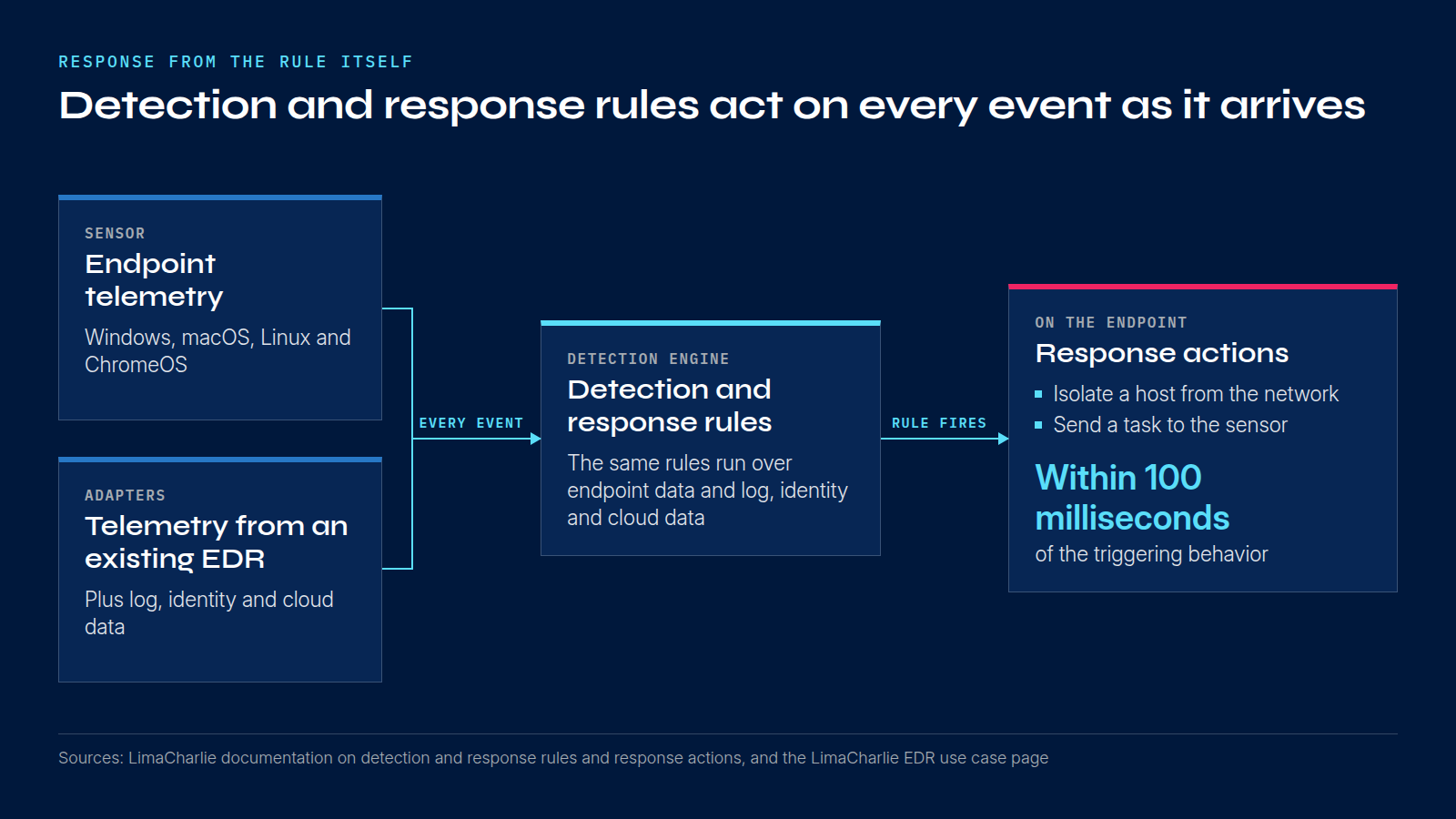
LimaCharlie is cloud-hosted security operations infrastructure that serves as an EDR, a SIEM or both. The sensor runs on Windows, macOS, Linux and ChromeOS, and adapters bring in telemetry from an existing EDR such as CrowdStrike, SentinelOne or Microsoft Defender. Because the same rules run over endpoint data and that log, identity and cloud data, LimaCharlie also works as an XDR.
The API is the product surface. In LimaCharlie, the API covers every platform capability, so anything an analyst does by hand can be scripted. You reach it through the REST API, the LimaCharlie CLI, Python and Go SDKs, and an MCP server that enforces the same permission model as the REST API.
The details a builder checks first:
Authentication: organization API keys exchange for a JWT that lasts one hour by default, and the Python SDK acquires and refreshes it automatically.
Rate limits: the REST API allows 500 requests per 60 seconds per key, or 1,000 for a bulk key.
Response from the rule itself: detection and response rules act on every event as it arrives, and their response actions, defined in the rule itself, isolate a host from the network or send a task to the sensor. Response actions run on the endpoint within 100 milliseconds of the triggering behavior.
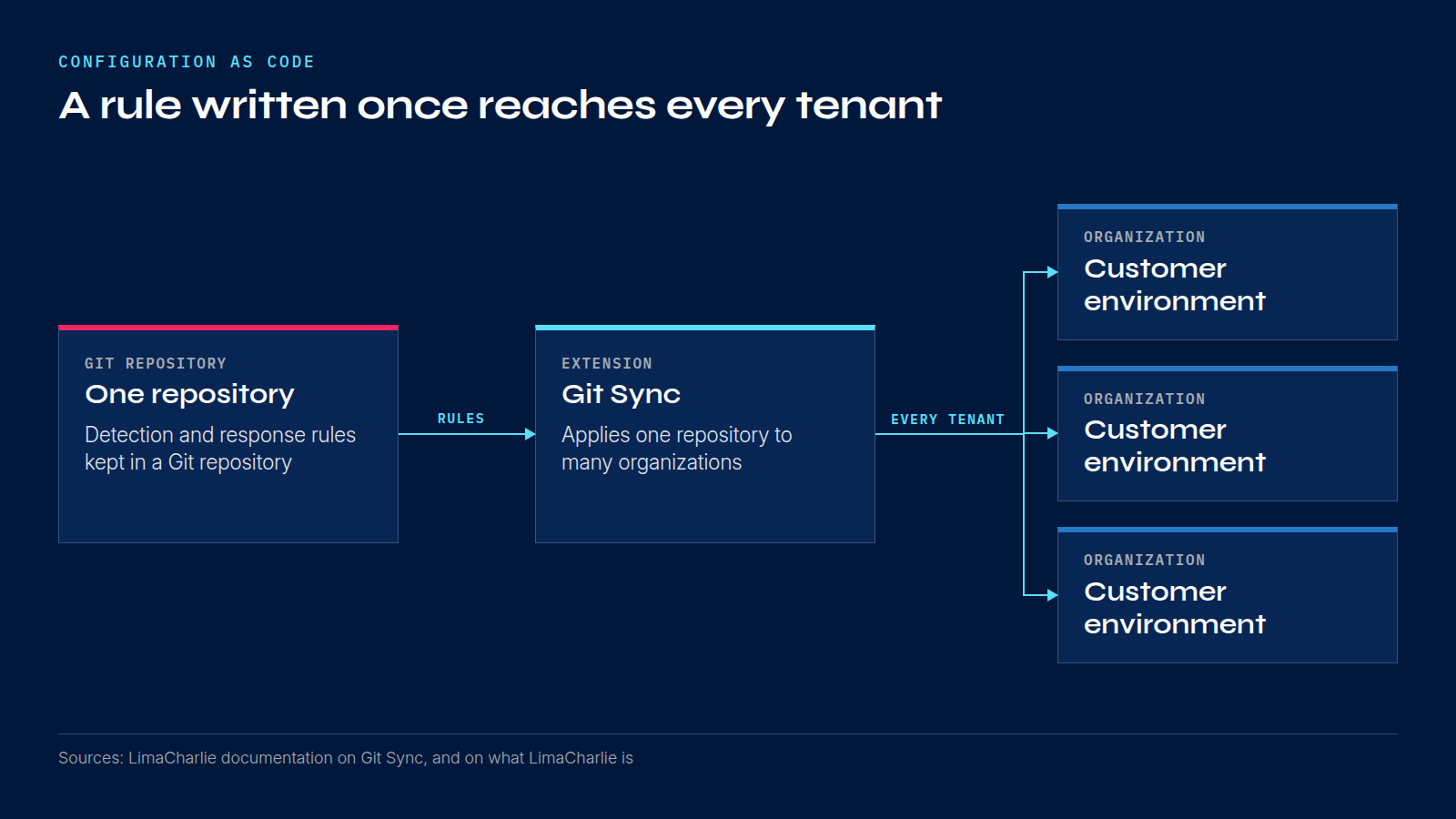
Configuration as code: Git Sync applies one repository to many organizations, so a rule written once reaches every tenant, and the CLI's
sync push --dry-runsimulates the sync and displays the changes that would occur.Your own code on detections: the Playbook extension, a LimaCharlie Labs feature, runs Python playbooks started by a rule, the API or the SDK.
Data out: outputs stream telemetry to webhooks, Slack, Splunk, S3 and other destinations.
Each environment is its own organization, so a service provider runs every client from one account. AI agents use the same CLI and API as your engineers, with every action on the record.
Where LimaCharlie fits and where it does not
LimaCharlie fits teams that write code or run agents against their security tooling: MSSPs and MDR providers automating many tenants, detection engineers who keep rules in Git, and teams that want response to run inside the detection engine. It also fits a team that keeps its current EDR and wants one automation layer over it, since adapters bring that EDR's telemetry into the same rules.
It is a weaker fit in three cases. If you want a vendor's SOC to watch and respond for you, a managed service such as Huntress Managed EDR does that work. If your organization already runs Microsoft Defender, the Microsoft Graph security API creates custom detection rules and runs KQL hunting queries over the past 30 days of Microsoft 365 Defender data. If you want prebuilt executive dashboards and a large catalogue of compliance report templates, LimaCharlie is closer to a build-your-own toolkit that exposes that surface through the API.
How to choose
Write down the three automations you need first, for example "isolate a host when a rule fires", "push one rule to 40 tenants" and "pull a week of process events for a case". Then check each vendor's documentation for the endpoint, the rate limit and the quota each one needs. Pricing for LimaCharlie is on the pricing page, and the free tier is full-featured.
Try LimaCharlie free today. Just sign up for the free tier on our website.
440 N Barranca Ave #5258
Covina, CA 91723
5307 Victoria Drive #566
Vancouver, BC V5P 3V6
Stay up-to-date on all things LimaCharlie with our monthly newsletter.
This site is protected by reCAPTCHA and the Google Privacy Policy and Terms of Service apply.