AI Action > AI Advice

Sr. Technical Content Strategist
From Advisory AI to Operational AI in Security Operations
The early wave of AI SOC platforms has delivered mixed results. While AI proved its usefulness as a triage assistant and next-step remediation advisor, these benefits came with significant drawbacks. Foremost, the cost of outsourcing an AI SOC is significant. Medium enterprises could expect to pay anywhere from $120,000 – $360,000 a year for the service. Large enterprises may pay upwards of $1M a year, depending on size.
Keep in mind, these are the costs businesses pay now. Current AI SOC pricing models rely on LLM costs that are unlikely to remain flat over time. AI vendors cannot indefinitely offer these services while incurring sustained losses quarter after quarter. The price of AI services will go up (or the vendors will exit the market), and when that happens, AI SOC costs will significantly increase.
There are also issues with LLM context windows, which refresh at a certain token limit, losing access to prior information once these limits are exceeded. Managing AI context windows while feeding them vast amounts of SecOps telemetry is tricky, leaving AI SOCs struggling to find an elegant solution.
A larger problem is that AI SOCs do not allow agents to operate directly in the environment. This means they fall far short of the vision of autonomous defenders actively countering adversaries inside production environments. Fortunately, LimaCharlie does deliver on this promise with its Agentic SecOps Workspace (ASW).
Fully capable agentic security operators
LimaCharlie’s Agentic SecOps Workspace lets AI function as a security operator, strictly governed by the permissions of the environment. AI agents can perceive telemetry, investigate detections, and execute response actions using the same APIs, workflows, and controls as security engineers.
This is possible because the LimaCharlie platform is open, unopinionated, and API-first. For us, AI is one more first-class component of a fully integrated security stack. In fact, you can bring-your-own-LLM and integrate it with the rest of your security operations, and empower it according to your risk appetite.
Every action taken by an agentic operator is observable, auditable, and reversible, representing a clear departure from black-box automation and advisory-only AI SOC models. This is not AI layered on top of legacy security tooling. This is AI embedded directly into the operational fabric of SecOps.
The difference in the two approaches becomes apparent when you visualize the architecture of an AI SOC and compare it to LimaCharlie's ASW. The AI SOC has siloed tooling where LLMs perform specific tasks. If you have a use case for AI that is not specifically supported, you’re simply out of luck.
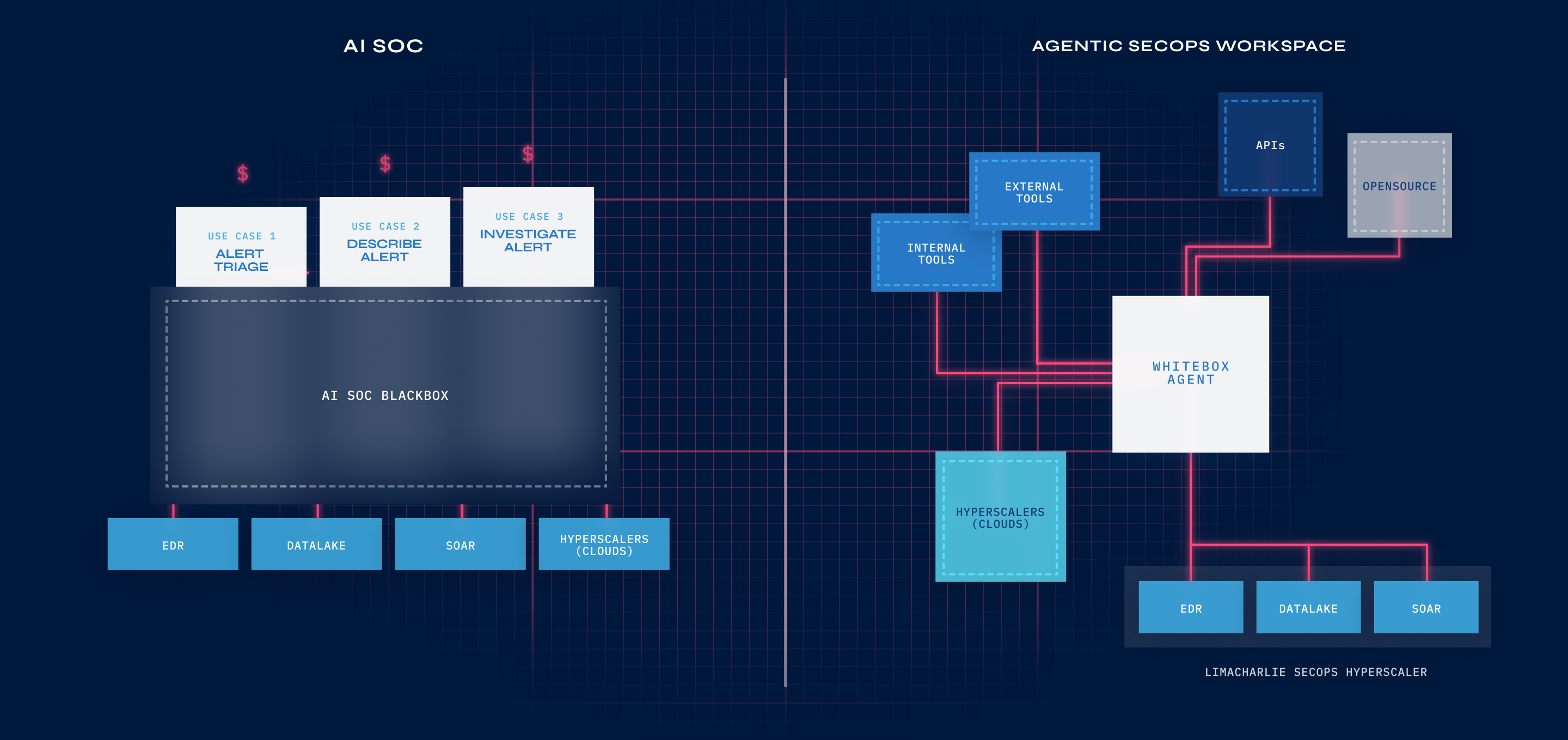
The Agentic SecOps Workspace integrates AI into the security stack by allowing LLMs to access every other integrated feature, exactly as a security analyst does. This opens the door for teams to integrate AI functionality into any security processes they desire.
MSSPs and security teams managing multiple tenants face scaling challenges that extend far beyond incident response. When operational tasks like deployment, configuration, detection engineering, onboarding, reporting, and daily maintenance increase, they must scramble to recruit more headcount. This drives up costs and erodes margins. The ASW breaks that linear scaling model by allowing AI to operate across the entire security lifecycle, scaling execution wherever human effort becomes a bottleneck.
While the differences between an AI SOC and LimaCharlie’s Agentic SecOps Workspace are considerable, they can be generally summarized as follows:
Value/Capability | LimaCharlie ASW | AI SOC | Details |
Detection Engineering: Rule ideation and query generation | ✅ | ✅ | Both technologies offer helpful suggestions to assist security operators. |
False positive reduction: filtering out noise to improve detections | ✅ | ✅ | Both technologies can reduce false positives and reduce alert fatigue. |
Tuning automation: Automated adjustments based on user attributes | ✅ | ✅ | Both technologies can adjust security posture on a per-user basis. |
Investigation: Enriching alerts, contextualizing information across systems | ✅ | 🟡 | Both technologies use automation to improve investigations. LimaCharlie’s capabilities scale easily across multiple tenants. |
Response automation | ✅ | 🟡 | AI SOCs can perform alert triage and suggest remediation steps. The Agentic SecOps Workspace empowers agentic AI as a full operator in the environment. |
AI report generation | ✅ | 🟡 | AI SOCs are generally limited to security reporting. LimaCharlie’s agentic AI can create detailed reports on security-adjacent domains such as IT operations, compliance, and engineering. |
Affordable testing | ✅ | ❌ | Lean AI SOCs average $120k-$360k a year to operate. An AI SOC analyst often costs tens of thousands of dollars annually. LimaCharlie is considerably more affordable to install, test, and operate. |
Headless Autonomy: AI agents perform SOC operations directly | ✅ | ❌ | AI SOCs alert and advise human operators but take no direct action. This puts them at a disadvantage when attacker activities are fully or nearly autonomous. |
Open integrations | ✅ | ❌ | Most AI SOCs restrict customers to vendor-selected models and closed orchestration layers. LimaCharlie supports bring-your-own-LLM. |
On-demand scalability | ✅ | ❌ | The Agentic SecOps Workspace is built on a cloud platform which scales effortlessly. |
Security teams can use the Agentic SecOps Workspace to grow operations without linear increases in cost. It’s not about replacing people, it’s about multiplying their capabilities and providing AI operators that scale as quickly as the environments they protect.
Direct benefits
AI SOCs primarily improve alert triage and remediation guidance at a steep cost. For a smaller investment, the LimaCharlie Agentic SecOps Workspace offers:
Superior operational speed and “headless autonomy”. The ASW allows AI agents to detect and execute autonomously, providing wire-speed defense. Humans stay fully in control through guardrails and policy, but no longer act as bottlenecks.
Operational simplicity. SOC stacks evolve into sprawling tool layers that rarely get consolidated. Each layer adds complexity, cost, and drag. LimaCharlie consolidates core SecOps functions into a single, API-first platform where AI operators can act natively. This significantly reduces operational friction and “death-by-a-thousand-tools.”
Full environmental context. ASW agents operate at the infrastructure layer, providing a holistic and accurate view of your environment. This is a major leap beyond bolt-on AI products that have limited visibility or require you to orchestrate several disconnected AI features into something functional.
Effortless scalability. LimaCharlie’s cloud-native architecture is built to scale with your environment automatically. From small deployments to massive, multi-tenant MSSP infrastructures, the ASW scales without the heavy operational overhead found in AI SOC platforms.
Richer, more flexible reporting capabilities. With full environment access, your preferred AI model can generate context-rich, visual, and executive-ready reports. For example, ASW agents can produce cross-functional reports across engineering, security, IT operations, and more.
Plain-speak operations for SecOps. With ASW, AI agents interact with your infrastructure through a unified API. This means operators can issue natural-language instructions like “Generate a list of detections related to CVE-XXXX-XXXXX across our environment.” The AI translates this into operational steps, eliminating scripting overhead and enabling far faster, more intuitive workflows.
Bring-your-own-AI flexibility. Choose the AI model(s) that performs best in your environment. Swap models, test alternatives, or fine-tune without being locked into a proprietary AI vendor. Your AI, your rules.
Know the future when you see it
While AI SOCs offer moderate improvements at high costs to SecOps, they don’t look like the future of AI in cybersecurity. Visionaries in our industry are not looking forward to a day when an AI chatbot can quickly parse logs or resurface remediation advice. That is a small step in the right direction, but it falls short of our ultimate expectations of AI.
The Agentic SecOps Workspace delivers on the vision of AI performing cybersecurity in live environments. It turns the long-imagined future of natural-language security operations into a practical reality today.
In other words, the LimaCharlie Agentic SecOps Workspace delivers AI security the way practitioners envision it should work.
Ready to see more for yourself?
Try the free community version: https://app.limacharlie.io/signup
LimaCharlie AI GitHub repo: https://github.com/refractionPOINT/lc-ai
Questions? Contact us for a deeper walkthrough: https://limacharlie.io/demo-request
440 N Barranca Ave #5258
Covina, CA 91723
5307 Victoria Drive #566
Vancouver, BC V5P 3V6
Stay up-to-date on all things LimaCharlie with our monthly newsletter.
This site is protected by reCAPTCHA and the Google Privacy Policy and Terms of Service apply.